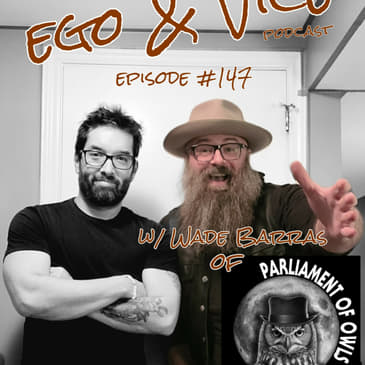
Wade Barras is a Canadian folk-rock artist performing under the name Parliament of Owls. Originally from Pembroke, Ontario, he has lived and worked across Canada, eventually establishing roots in Cornwall, Ontario. Wade is known for his groove-heavy acoustic guitar style and "gravel-coated" lyrics that reflect his life experiences, which include love, loss, and personal growth.
In 2023, he debuted his first single, Shallow Holes, part of his album Volume 1, which he plans to release on vinyl. Wade is committed to sharing his music broadly, performing at unique venues to create memorable experiences. His artistic journey emphasizes living authentically and sharing stories through music.
https://parliamentofowls.bandzoogle.com
Egoandvicepodcast.com
Ottawagigs.ca
E&V
[00:00:01] Not sure what to do in Ottawa tonight? Not even sure where to start looking? I got a website for you. Go to ottawagigs.ca. Whether you're looking for a band, whether you're looking for an artist, whether you don't know what you're looking for. Maybe some live music or just a fun night out on the town. Start with ottawagigs.ca and find everything you need.
[00:00:22] Bands, artists, venues, dates, times, even door covers. It's really all at your fingertips on an easy to use website. ottawagigs.ca. Go discover the amazing talent, the amazing venues, the amazing nightlife that Ottawa has to offer. Start your evening on ottawagigs.ca. It's your guide to the gig.
[00:00:47] You've got a real attitude problem, McFly. You're a slacker.
[00:01:53] Hey, it's Mike. This is episode 147. This is Ego and Vice. Welcome back. How's everyone doing? Good. Season eight is winding down. Yeah, there's only a handful of episodes left. And then I'm going on my annual snowboard retreat to the mountains. Bye bye. I'll be gone for a month or so. I always say that, but then I'm gone for like two months. Anyway, play it by ear. I like to go out and do stuff. I like outside. I love winter.
[00:02:22] Everyone knows that I'm crazy, but I do. Anyway, got to get right to it. On the podcast today, I have a very talented guest. His name is Wade Barris. He represents a band or he is the band, Parliament of Owls.
[00:02:38] A local musician, a local business guy, marketing guy, social media, content creator. He does a lot. He does a lot in a small amount of time or a small amount of space. I don't know what I'm saying.
[00:02:54] But yeah, super, super interesting guy. Very creative guy. Very talented guy. He came by and we had a really good chat and we discussed everything Parliament of Owls and his approach to creating his art, his music, his ideas, bringing them all to fruition. It's very interesting. So please listen to the podcast. But that's why you're here, right?
[00:03:18] Anyway, I'm going to play a song from Wade and his band, Parliament of Owls.
[00:03:25] On the other end, we're going to come back and we're going to have that conversation with Wade Barris.
[00:03:30] So this is Parliament of Owls. This is a song called Shallow Holes. Right here. Episode 147, Eagle and Vice.
[00:03:39] Hey, we're back. This is Eagle and Vice. This is episode 147. As promised in the intro, sitting with me, I have Wade Barris, or also known as Parliament of Owls.
[00:07:55] That's true.
[00:07:55] How's it going, Wade?
[00:07:56] I'm doing good. That is me. I am Parliament of Owls.
[00:07:59] You are.
[00:08:00] Thank you so much for showing up to my lovely South Hood studio, which is kind of in the middle of a renovation.
[00:08:07] But it turned out pretty good. I started yesterday and it was completely upside down, so I actually gave you a shout and said,
[00:08:14] it might be a little crazy when you come here, but I actually got it together. What do you think?
[00:08:18] I think it looks really nice. You've painted everything and it's a very nice color.
[00:08:22] Yeah. I'm a big fan of purple, so it was time to purple up my life a little.
[00:08:28] Yeah, it's very Prince of you.
[00:08:30] Yeah. So, Parliament of Owls.
[00:08:35] Can you explain what that is? Where'd that come from? I know you are a singer-songwriter or a solo artist.
[00:08:44] I go on some of your social media. I've seen your releases. You do full band stuff. You do acoustic stuff.
[00:08:52] Maybe just reach back and just start somewhere at the beginning. Whatever you consider the beginning of music.
[00:08:57] Yeah. So, I've only kind of been in this journey for a little over a year and a half.
[00:09:03] But the Parliament of Owls, if you want to say it, it's a canopy of, I guess, different ideas that I may have.
[00:09:11] It's definitely music-driven. It's me that writes and creates and records all this music.
[00:09:18] There are different kind of elements of having a band.
[00:09:22] Ideally, I would rather play with a band every day of the week than play solo shows.
[00:09:27] But it's just kind of to facilitate, I guess, the kind of need to continue to play as I play a lot of solo shows, acoustic.
[00:09:36] I have a couple different kind of variations of the band.
[00:09:40] And my goal, because I find it really, really difficult to be able to have a band commit to what you want to do, follow your dream.
[00:09:49] It's especially a little bit older in age.
[00:09:52] It's a lot to ask.
[00:09:54] So, my goal right now is to kind of have regional bands, so to speak.
[00:09:59] So, if I play in the Ottawa Valley, I might be able to draw from musicians down there that we all have our own sort of vibe through Ottawa, through Kingston.
[00:10:08] And that's the goal just for me to be able to facilitate being able to continue to play as a band.
[00:10:13] But, yeah, it's the Parliament of Owls.
[00:10:16] It's me.
[00:10:17] But, you know, I want it to be kind of at some point, if things go well, to be kind of like how the Desert Sessions were with, like, the Queens of Stone Age guys and, like, PJ Harvey and all those people.
[00:10:27] That's kind of like whoever kind of comes in and out of that is still part of that Parliament of Owls.
[00:10:32] But, ultimately, it's myself that, you know, I write, record, and do all that stuff.
[00:10:37] But, yeah, I can relate to that.
[00:10:38] I've always been in bands throughout my life, but it's always like I always fall back onto – because I write everything on an acoustic guitar anyway.
[00:10:45] And I've primarily throughout my life, I've always played, like, punk and rock and stuff like that.
[00:10:50] But I write everything on an acoustic guitar.
[00:10:53] And somewhere in between, you know, I always end up writing these acoustic songs.
[00:10:57] And I go perform on the down times or in between times, I'll do acoustic gigs.
[00:11:02] Right?
[00:11:02] But I can relate with you.
[00:11:04] My passion or my main thing I want to do is play with people in a band, loud, in a room, stuff like that.
[00:11:14] It's great doing acoustic stuff, but it just – it doesn't have that same kind of – it doesn't scratch the itch as much, you know?
[00:11:20] I agree 100%.
[00:11:21] I love – and especially whenever I play as a band, it allows me to free up myself to be more of a showman, to be more of a character, which I think is my, you know, a good quality that I have.
[00:11:35] Definitely.
[00:11:36] Whenever I'm playing, like, solo shows, a lot of them are, like, you know, brew pubs and stuff like that.
[00:11:41] But there's a lot of people that are at those places, first to socialize with their friends, second to eat and drink, third to maybe listen to music.
[00:11:50] So I always struggle because I kind of have to hold back my identity playing those places.
[00:11:55] But, yeah, playing in a band would be great.
[00:11:57] A lot of the music that I write also, like, if you listen to it, it's always – some of it's heavier, some of it's lighter, but it's all based around an acoustic guitar.
[00:12:04] And that's just out of necessity that that means that I could strip it down and play my songs just acoustic or I could have a band and beef them up and have them be a little louder and heavier type of thing.
[00:12:15] Yeah, that's great.
[00:12:16] That's great.
[00:12:17] That's songwriting, right?
[00:12:19] You can consider yourself – do you consider yourself a singer-songwriter?
[00:12:22] I don't know if I do.
[00:12:23] I've never really – to be honest, I've never really thought about that.
[00:12:25] I'm just trying to move forward.
[00:12:28] I only started singing about a year and a half ago.
[00:12:31] I'd never sang anything in my life to anybody on the planet.
[00:12:34] So nobody on the planet had ever heard me sing.
[00:12:37] I had a marriage prior and my wife at the time wasn't really musically inclined, so, like, never really gave the support because she never really knew anything about it.
[00:12:49] So I always thought, well, I guess I could never sing.
[00:12:52] And my wife now, she's said, you know, you could actually sing.
[00:12:56] You should sing.
[00:12:56] So I kind of grinded through that initial phase of not being able to play and sing at the same time.
[00:13:01] Thought it was hopeless and then things just started to click.
[00:13:04] So I've only been singing for just over a year and a half type of thing.
[00:13:09] So to say, am I a singer-songwriter?
[00:13:11] I'm working towards it.
[00:13:13] I think it's all going to be kind of in your peripheral, though.
[00:13:15] So I think at some point I'll look back and say, oh, yeah, I definitely am.
[00:13:18] At this point, I'm just trying to move forward.
[00:13:21] Yeah, as long as what you're doing is what you want to do.
[00:13:25] And for me, it was I needed to kind of draw a line in the sand in my life.
[00:13:29] So I've been working in management for large companies for years and years.
[00:13:34] And just because you can do something and you're good at it doesn't mean that's what you should be doing.
[00:13:39] So I was good at it and I could handle those things.
[00:13:42] But ultimately, I hated it.
[00:13:44] You know, I'm working for large companies that it was a very toxic culture that, you know, they would look at you like you should be preparing like you're a Navy SEAL.
[00:13:53] But we're putting pampers on a trailer.
[00:13:56] You know what I mean?
[00:13:56] Like it's it's it got really, really tiring.
[00:13:59] And I remember like I was working my way up and I was interviewing for like a higher position because they force you into that.
[00:14:06] Like if you say no to a position, then you never get that opportunity again.
[00:14:09] So right.
[00:14:09] That was punish you if you don't.
[00:14:10] So if you're not if you're not at that stage for that, then they don't want anything to do with you.
[00:14:16] So it's very toxic.
[00:14:17] You can't just enjoy what you're doing.
[00:14:19] You always have to go for that next goal.
[00:14:20] And I remember interviewing and, you know, just it dawned on me like I don't want this position I'm going for.
[00:14:29] I don't want my current position.
[00:14:31] I don't want anything to do with this stuff.
[00:14:32] I'm miserable.
[00:14:33] Why would anybody want this?
[00:14:34] And I remember people.
[00:14:35] So I quit right then and said, I'll take a chance on being a musician.
[00:14:40] Even if I fail at it, did I really fail?
[00:14:42] You know what I mean?
[00:14:43] Because most people will just grind through that life and be miserable.
[00:14:47] And I just said, fuck it.
[00:14:49] I'm going to go for it.
[00:14:50] And I'm going to start doing this.
[00:14:51] And I'm going to work hard.
[00:14:53] And I'm going to fail a lot.
[00:14:55] But fuck anybody, you know?
[00:14:57] I think that's the way you have to do it.
[00:15:00] And what you said earlier about just because you're good at something doesn't mean it should be the thing you do, right?
[00:15:08] It's just like you should love what you do or at least like what you do.
[00:15:11] At the very least, like what you do.
[00:15:12] And if you don't like what you do, do it for a purpose and get paid for it.
[00:15:17] But I think in any situation throughout my life, I've been in bands.
[00:15:22] I've done solo stuff.
[00:15:24] I've toured through Canada.
[00:15:25] I've toured through the States.
[00:15:27] It's always been in my life music.
[00:15:30] But I've always had a balance because I've always had a career.
[00:15:33] Because I know being a musician realistically, and I'm not saying anybody, you can't make it.
[00:15:39] You can.
[00:15:40] And there's definitely a lot of different ways to make money.
[00:15:43] But for what I was doing, I don't play cover songs because I think I fuck them up and they sound off.
[00:15:47] Why would anyone want to hear me play Wild Horses by the Whirling Stones, right?
[00:15:51] Because it'll sound awful.
[00:15:52] Go listen to the CD.
[00:15:53] So I just always wrote my own music.
[00:15:55] But I knew somewhere down inside, it's like the idea of making a living, a sustainable living where I can keep going, going, going until I'm old and I can sustain myself is really hard to do.
[00:16:08] It's a lot of work.
[00:16:09] And you can try.
[00:16:10] It's very, very noble that people don't try.
[00:16:12] But I've always felt better about having something to fall back on.
[00:16:18] Because just, I don't know.
[00:16:19] That's where I'm at.
[00:16:21] And like I said, I don't play cover songs.
[00:16:23] And a lot of people may.
[00:16:24] I have friends that are in a cover band that play weddings and stuff.
[00:16:27] And they make great money.
[00:16:28] Or I have other friends that play pubs.
[00:16:30] They're that guy in the corner that everybody fucking ignores.
[00:16:33] But he sits there and plays three sets of covers.
[00:16:36] And I do do those things.
[00:16:37] And it definitely is.
[00:16:38] See, I'm taking stuff away from that that might not be what other people might take away.
[00:16:44] I'm taking away as like I need to have 10 years of experience in 10 months.
[00:16:49] So I'll play to these places that don't even acknowledge me because it's a bit more of a, I guess, a character build, so to speak, of knowing what it feels like to fail.
[00:16:57] But for me, like of what I'm doing with like Parliament of Owls, it's not, I'm basically just trying to move decimal points.
[00:17:05] So I'm the guy that's at a large company that's getting everybody to pool their money on lotto tickets because there's a slightly better chance at success.
[00:17:14] And what I mean by that is, you know, I make with my production partner, I make my own music videos.
[00:17:20] We want to do that.
[00:17:21] We want to be, you know, be able to make music videos on a budget for other musicians.
[00:17:25] We have our own production company called Next Street Over Productions, which we have a little YouTube show called Indie Business where we go to like a local small business, interview the owner.
[00:17:37] And then I play a couple songs like in the venue.
[00:17:40] So we've done like donut shops, burger and fry places, Mexican restaurants.
[00:17:44] Yeah.
[00:17:44] So we sit down.
[00:17:45] It's, you know, like after, after a place closed, we also did like a hobby store, like RC cars and stuff like that.
[00:17:50] Oh, that's cool.
[00:17:50] Then yeah.
[00:17:51] Cause then it's like, you're in the, yeah.
[00:17:52] All right.
[00:17:52] I get it now.
[00:17:53] Yeah.
[00:17:53] Then we'll profile the business owner.
[00:17:56] So it'd be like after hours, it'd be like what we're doing right here.
[00:17:58] I'm sitting across, we have questions, just, you know, how they've approached their business and stuff like that.
[00:18:03] Then afterwards, either I play to nobody or we have had ones that we've had crowds and stuff like that.
[00:18:10] I think it's really important for anybody to be creative and to put something back in the world because we take and we take throughout our entire lives.
[00:18:17] We do.
[00:18:17] And if you have something inside of you that can give back, whether it be music or whether it be some kind of content or some, just your imagination, like some of that stuff you came up with on your own or with your friends or whatever.
[00:18:28] And you, and you, you had these ideas, which you've created from nothing and said, Hey, let's try this.
[00:18:33] I think that's, I wish you nothing but the best in all of that.
[00:18:37] You know what I mean?
[00:18:37] Because I think people should, creative people should be creative and they should put things back into the world and they should reach out to as many people to say, Hey, but in the, in the end, as long as you love doing it.
[00:18:51] And it doesn't become just like a job trying to see whatever, because in the end for me, it would always be about, am I, do I get to play music here?
[00:18:59] You know what I mean?
[00:19:00] Do you find that sometimes the machine takes over from the playing or the, uh, not yet.
[00:19:05] So the only real, you know, like issue that I would have is, um, I guess kind of the nature of the business when it comes to performing.
[00:19:12] So all these other things that I want to do is, you know, is almost like patting a resume of like, cause I would love to, at some point, even with the show, I was talking about indie business, um, to scale back and not perform, but to also have an independent artist in that area.
[00:19:28] Right.
[00:19:29] Be the performer.
[00:19:29] And I could just be the host of it.
[00:19:31] Um, for something like that, like I just kind of looked at, um, with social media, it all becomes a wash of like pure multi-level pyramid schemes of people saying like, here, do the, you know, look at this, look at this, sign up for this.
[00:19:41] And for me, it was like any like good, hardworking small business, um, that does that on social media.
[00:19:49] Nobody really follows.
[00:19:50] So I wanted to have kind of another option of saying like, Hey guys, there are some really good businesses local.
[00:19:55] Cause after the COVID-19 I found like, or prior to COVID-19, um, it was always like sense of community, support your local business, you know, stop in, you know.
[00:20:05] And I find after that, it just kind of seemed to go away in my opinion that it's, we're not really putting the focus on the small businesses.
[00:20:12] It's, you know, order online.
[00:20:14] Don't leave your house.
[00:20:14] What's the next thing we can.
[00:20:16] Yeah, I get it.
[00:20:17] I know.
[00:20:18] I totally know what you mean.
[00:20:18] I never thought about that either.
[00:20:19] Yeah.
[00:20:20] Cause that's all there was.
[00:20:21] It was just like, we have to help these businesses.
[00:20:23] And now it's like.
[00:20:23] No, you never really hear those terms of.
[00:20:25] I guess.
[00:20:26] I guess we just assume everyone's doing good now.
[00:20:29] Which they're not, you know, a lot of, a lot of businesses got completely screwed over for, you know, that period.
[00:20:34] A lot of them failed.
[00:20:35] A lot of them aren't around and they've had their whole livelihood taken away, you know, in a matter of months.
[00:20:41] So for me, it's, it, that's the goal is to be able to shine an alternative way to help promote these small businesses.
[00:20:48] And at some point to help promote indie bands as well, because it's the same sort of deal with social media.
[00:20:54] You know, it's following my buddy's band and nobody looks at it, you know?
[00:20:57] Yeah.
[00:20:58] It's really hard to crack that now because there's just so much, so much content, so much choice.
[00:21:04] People go on Spotify and they literally have every single song ever written at their fingertips.
[00:21:09] And they might listen to four artists or they'll listen to 30 seconds or something.
[00:21:13] It'll be like, next, next.
[00:21:15] So it's like, how do you break through in something like that when you're just kind of like a drop in a very, you're a drop of a drop of a drop in a giant bucket.
[00:21:23] You have to do what you do.
[00:21:25] You have to be creative.
[00:21:26] It's like, you can just be like a musician and say, I wrote some songs.
[00:21:29] I'm going to put them all out on YouTube.
[00:21:31] I hope you listen to them.
[00:21:32] It's like you and a billion other people.
[00:21:35] But if you have, I have this song, which is attached to this, this, and this, which is something different or something creative.
[00:21:42] You know what I mean?
[00:21:44] There's that saying in Barenaked Ladies.
[00:21:46] Thank God they're Canadian.
[00:21:48] Ah, they're Barenaked Ladies.
[00:21:49] But they have that song.
[00:21:49] It's all been done.
[00:21:52] Like that was 20 years ago they released that song.
[00:21:54] And I'm like, what are they talking about?
[00:21:55] But it's all been done, right?
[00:21:58] So.
[00:21:59] I struggle with that.
[00:22:00] I see some of my peers that have the clickbait that they use.
[00:22:05] You know what I mean?
[00:22:06] Like, and I can never do that.
[00:22:08] And I'm a different person.
[00:22:09] Like I don't see things the same way.
[00:22:11] So I don't ever want to do something similar.
[00:22:12] The good news with, you know, nowadays with, you know, the age of technology is like we're able to make an indie show about small businesses.
[00:22:20] We're able to do our music because we just did a music video for my last single.
[00:22:25] And we filmed it all and then projected it on like a drive-in theater.
[00:22:31] Cool.
[00:22:31] Yeah.
[00:22:31] And then did like a video within the video type of thing.
[00:22:34] Yeah.
[00:22:35] We're able to do that now.
[00:22:36] You know what I mean?
[00:22:37] Like, and it was very cheaply done.
[00:22:40] But yeah, you got to be creative.
[00:22:43] And for me, like with this Parliament of Owls blanket that you want to call it, it's I want to be known for music.
[00:22:50] But that's not what I want to be known for.
[00:22:53] I want to do things.
[00:22:54] I look at people like, and it may be kind of an odd comparison, but somebody like a Henry Rollins or even like a Rob Zombie.
[00:23:03] That it's like they're able to kind of go through different media and create different things.
[00:23:07] You know, Henry Rollins has been host of shows.
[00:23:09] He's been, you know, public speaking.
[00:23:11] He's been so many things on top of him.
[00:23:13] Arthur, he's a...
[00:23:13] Yeah.
[00:23:14] Yeah, he's a...
[00:23:14] Yeah, he's...
[00:23:16] Yeah, he's just...
[00:23:17] He's in everything.
[00:23:17] He's like a...
[00:23:18] He's like a renaissance man.
[00:23:20] Mm-hmm.
[00:23:20] And that's kind of what...
[00:23:21] He's a brand is what he is.
[00:23:22] Yeah.
[00:23:22] You know what I mean?
[00:23:23] And I suppose that that would be the ultimate goal is to be associated with a bunch of different things that people enjoy all of them.
[00:23:31] It's not like, oh, now he's trying to do this, you know?
[00:23:34] Yeah.
[00:23:34] Just have them all be like, yeah.
[00:23:36] Yeah, because...
[00:23:36] Well, either way.
[00:23:37] You know what I mean?
[00:23:38] Like, you'll always have fans.
[00:23:39] You'll always have critics, right?
[00:23:41] But if you have the idea of it, like, why...
[00:23:44] Yeah, why stick to the one thing?
[00:23:45] Why pigeonhole yourself?
[00:23:46] Like, I'm a musician.
[00:23:47] It's like, what if I want to host this podcast?
[00:23:50] What if I want to do this?
[00:23:51] I guess this is kind of what I do, too, because I was always a musician.
[00:23:54] And I wanted to start the podcast, like we talked about off mic there.
[00:23:57] I wanted to start the podcast just to kind of give back to the local music.
[00:24:03] Because when I was young coming up in a local band, it was hard as hell to crack the scene, right?
[00:24:08] Nobody gave a shit.
[00:24:09] Nobody was coming up to me saying, hey, brand new band.
[00:24:13] We want you to come on our show and tell your story.
[00:24:15] Nobody give a shit, you know?
[00:24:16] So that's what I wanted to do for, like, local bands.
[00:24:19] So I guess I'm kind of doing that, too.
[00:24:20] Yeah, I'm an opportunist.
[00:24:22] And you can't expect opportunities if you don't put your hand into trying to create them.
[00:24:28] You know what I mean?
[00:24:29] So that's what I'm trying to do is to create, be in charge of creating different opportunities
[00:24:34] that may come my way that I could say, wow, this was a cool opportunity.
[00:24:37] So I don't want to only focus on music and say, this is all I do.
[00:24:41] I want to have different things that are super engaging to me that people enjoy, that I could be creative.
[00:24:46] You know, I'm a big fan of photography and lighting, stuff like that.
[00:24:49] Yeah, yeah.
[00:24:49] And, you know, all these things I'm trying to learn, like I said, to have a better chance of winning, you know, that lotto in a big factory.
[00:24:57] I get that now.
[00:24:58] Yeah, I totally get what you're saying now.
[00:24:59] Yeah, I hope I just get that chance because I think that I have a lot to offer.
[00:25:05] And I do, I always say that I cast a very large shadow wherever I go.
[00:25:10] And I just hope that, you know, I have enough time on my side to be able to have people kind of pick up on what I'm doing because I'm trying to do the best I can in a very unselfish way.
[00:25:25] It's because I think that I could entertain.
[00:25:27] I think I have a lot to offer that people could really enjoy.
[00:25:30] And also, like, I just, I see the world different.
[00:25:33] So, like, anything that I see that might be on social media or, you know, say on YouTube of different ideas, never once do I ever think, oh, I should do that.
[00:25:41] You know what I mean?
[00:25:42] I mean, I always definitely have my own ideas, even with my production partner, Aidan Eifer.
[00:25:48] It'll be like, this is my idea.
[00:25:50] And it's already in my head.
[00:25:51] It's not like, hey, I saw somebody do this or do that.
[00:25:54] It's this is my idea.
[00:25:55] How do we make this work?
[00:25:56] And I'm very fortunate.
[00:25:58] It can be lonely at times, you know, but I just think that I have so many ideas that I hope could come to fruition because I think it would be very entertaining for people.
[00:26:08] But like I said about the show Indie Business, the toughest and also a lot of, like, we have had a bunch of music video ideas that we can never get over the finish line because people don't want to commit.
[00:26:18] And, you know, like, there's been places that we wanted to use aesthetically.
[00:26:22] And they said, yeah, yeah, man, that sounds great.
[00:26:24] Sounds great.
[00:26:24] Now, either be within, like, the week before we film or there's been one that was the night before that I said, just so we're cool.
[00:26:32] I'll be here at this time.
[00:26:33] We'll be doing this.
[00:26:34] Yeah, yeah.
[00:26:34] Bailed on you?
[00:26:35] Yeah, we're not doing it.
[00:26:36] That sucks.
[00:26:37] And, yeah, same with Indie Business.
[00:26:38] Like, all the promotion that we do is 100% free.
[00:26:41] So we don't charge the businesses a cent for us to come and give free promotion.
[00:26:45] Right.
[00:26:45] The one that we did at, it was 110 Hobbies in Pembroke Hobby Store.
[00:26:49] I think on YouTube it was, I think, like 5,300 views, which is not bad for, you know, a 20-minute long segment.
[00:26:56] That would be a good day in a lot of artists.
[00:26:59] Yeah.
[00:27:00] McGuire's Donuts was 2,700.
[00:27:04] You know, I just, but the problem is I never get feedback.
[00:27:07] And as much as I am very confident in what I do, I also do need reassurance for things.
[00:27:13] So it's difficult when you put it out there and you never hear anybody say, like, anything.
[00:27:18] For me, I've always struggled with that.
[00:27:20] Yeah, that's fair.
[00:27:21] I understand that.
[00:27:22] And it's hard to ask for it too, right?
[00:27:24] Because it's just like, so tell me what you thought about whatever.
[00:27:27] And it's just like, it's nice when it comes genuinely, right?
[00:27:32] I really liked what you did.
[00:27:33] Wow.
[00:27:33] I'm glad you, I didn't expect that.
[00:27:35] That's great.
[00:27:36] You know?
[00:27:36] Because that does help.
[00:27:37] You think, okay, I'm doing the right thing here.
[00:27:39] For sure.
[00:27:40] But I think, would you do it anyway though?
[00:27:43] Uh, enough times before I'd stop tuning it.
[00:27:46] Yeah.
[00:27:47] I do it a few more times.
[00:27:48] Yeah.
[00:27:48] And isn't, isn't it with like the internet nowadays, it's like with the clikes, the clikes,
[00:27:53] the clicks and the likes and the follows and stuff like that.
[00:27:56] If they just started diminishing, that's like your audience.
[00:27:59] So you'd know what was working and what wasn't, right?
[00:28:01] Yeah.
[00:28:01] So I think just bringing it up, like you're up in like 5,300 and stuff, you're doing something
[00:28:06] right.
[00:28:07] Yeah.
[00:28:07] Because, you know, I think in any content, it's just like, it's, you know, just to have
[00:28:13] people pay attention to it to that extent, even if it's just in like the four digits,
[00:28:18] that's huge.
[00:28:18] It's huge.
[00:28:19] And it's like, this is a terrible cliche, but Rome wasn't built in a day.
[00:28:24] You know what I mean?
[00:28:25] So you just got to keep plugging away and that's what it is.
[00:28:27] It's time, disregard, hard work, and just keep grinding away at the stuff that works
[00:28:33] and maybe just let go of the stuff that's not worth it or you feel like it's not worth
[00:28:38] it.
[00:28:39] And eventually something will definitely come out of it.
[00:28:42] Let's play a Parliament of Owls song.
[00:28:44] Would you like to choose one?
[00:28:46] Let's do the newest one, Painted Wild Horses, if we can.
[00:28:52] All right.
[00:28:53] You heard it from Wade himself.
[00:28:54] This is Painted Wild Horses from the Parliament of Owls right here on Ego and Vice.
[00:28:59] Peace.
[00:32:37] So Parliament of Owls, I was looking at your, I was doing some research as much as I could
[00:32:43] on your back catalog back in July of 2021 is when I basically could see the earliest
[00:32:49] releases and they all kind of came out within that month.
[00:32:52] You had Playing Hero, Intro, Ghosts, Eye for an Eye, and they were all kind of solo acoustic
[00:33:00] stuff, right?
[00:33:01] Yeah.
[00:33:01] Were those the first ones you released?
[00:33:04] I think Playing Hero was the first one I released and then I realized, oh, I have some other
[00:33:08] music that was recorded prior that I just kind of dumped in there as well.
[00:33:11] And that was the three other ones.
[00:33:16] So around that time, it would have been pandemic time.
[00:33:19] I said like, I want to go to a studio and just see, you know, I'm going to pay to pretty
[00:33:26] much just explore in a studio and see what is it like to be in a studio?
[00:33:29] Can I do this?
[00:33:30] Does this, you know, is the verbiage going to make sense to me?
[00:33:34] So yeah, I went to, who I think is a friend of yours, Jordan Zadarozny.
[00:33:38] Oh, did you?
[00:33:39] For those first three.
[00:33:41] And they're not complete.
[00:33:42] They're not, you know, they're just, okay, what do I do?
[00:33:45] Yeah.
[00:33:46] You know what I mean?
[00:33:46] So yeah, those first three, Intro, Ghosts, and Eye for an Eye, I did there.
[00:33:53] There was another one that I did too, but it was just terrible.
[00:33:55] And I don't think I even have a copy of it, but it was all for me just like, I wasn't
[00:34:01] going to ever release those.
[00:34:02] I just figured after I did playing here, I'm like, well, there's these other three I could
[00:34:06] probably put on Spotify too, and maybe somebody might enjoy them.
[00:34:09] But yeah, that was what Jordan and Jordan taught me a very valuable lesson that he wouldn't
[00:34:15] know because I never spoke to him about this.
[00:34:17] But the big difference between what you pay for an engineer's service and what you'd
[00:34:22] pay for a producer's service.
[00:34:24] So I, you know, paid him, you know, to be an engineer more or less, but in my head, not
[00:34:29] really knowing the lay of the land, I thought, well, is he going to say like, try this and
[00:34:33] maybe this is going to work.
[00:34:34] And he said, okay, so what are we doing, Wade?
[00:34:37] And he said, well, we're going to do this.
[00:34:38] And then he recorded, he said, okay, so what's next?
[00:34:41] Maybe this.
[00:34:41] Okay.
[00:34:42] What's next?
[00:34:42] Well, I think I'm done.
[00:34:43] Okay, great.
[00:34:44] You know, like, well, I'll mix this and there you go.
[00:34:46] And that was a really valuable lesson for me to know that you need to be prepared.
[00:34:51] To people that are musicians, you might think like, of course you do dummy, but like me getting
[00:34:56] into this without really having any history of how you do this.
[00:35:00] It was, you know, a very valuable lesson that cost me a little bit of money to learn.
[00:35:07] Sure.
[00:35:07] I think with Jordan too, is like Jordan has been, Jordan's like a really good friend
[00:35:12] of mine.
[00:35:12] I've been going to him for 25 years.
[00:35:18] Jordan respects the art.
[00:35:19] If you go up and you, like, he'll produce your stuff.
[00:35:22] He'll give you advice, but he's not going to mess it up unless you ask him to, right?
[00:35:27] He trusts the art.
[00:35:28] He's like, if you're going up and saying, I have these songs I want to record, he'll
[00:35:31] be like, great.
[00:35:31] And he'll record them and it'll make them sound great.
[00:35:33] But if you don't, you know, if that's what you have, that's what you have.
[00:35:37] But if you say, I need your help, I need your help, then he'll definitely help you.
[00:35:41] But yeah, that was, it was valuable because I, I wanted to see, can I do this?
[00:35:46] If you're going to put a click, do I, am I able to keep up with it?
[00:35:50] Right.
[00:35:51] And how did it go?
[00:35:52] Like no issues?
[00:35:54] Like everything recording wise, was it what you thought it was going to be?
[00:35:57] Well, other than the producer and engineer part?
[00:36:00] It's, it's hard to kind of reflect back.
[00:36:03] I think I, I learned the hard way some, some things, but no, it was all somewhat similar
[00:36:10] to what was in my head, you know?
[00:36:12] And yeah, my, my spouse actually likes those, those songs.
[00:36:17] She likes Eye for Nine.
[00:36:18] She likes Ghosts.
[00:36:19] For me, when I listen to them, I think, well, they're not finished.
[00:36:21] You know what I mean?
[00:36:21] They're just kind of, you know, at the beginning, to me, they're like a demo.
[00:36:26] You know what I mean?
[00:36:26] That you're like, okay, I understand that the song idea is there.
[00:36:29] Now we can make a proper song.
[00:36:31] But yeah, after I did, I went to, to work with a gentleman named Ross Martin to properly
[00:36:38] do a song.
[00:36:39] And that was called Playing Hero, that I did everything on it.
[00:36:43] So everything that you hear on it is recorded by me.
[00:36:47] And I wanted to make a full song.
[00:36:50] I didn't have a drummer, so everything was just done with, you know, claps and stomps
[00:36:54] type of thing.
[00:36:55] But for that particular song, it fit the, I guess, the, you know, the aesthetics of
[00:37:01] the song.
[00:37:02] And yeah, once I released that, I thought, okay, I could do this now.
[00:37:05] Like, I, this makes sense to me.
[00:37:06] I don't feel out of place when I go into a studio.
[00:37:09] I could get everything out.
[00:37:11] I could keep up.
[00:37:12] So yeah, whenever I released those three songs I did with Jordan, it was just kind of like,
[00:37:15] I'll just dump these on here too.
[00:37:17] But they were never intended to be like a release.
[00:37:19] Because in my opinion, they're, they're not complete.
[00:37:21] They're just demos.
[00:37:22] Yeah.
[00:37:22] If you just go up there with a guitar and like record some songs or just, it's going to be
[00:37:27] what it's going to be, right?
[00:37:28] It's going to be kind of, yeah, glorified demo.
[00:37:31] But it's just, did you always like write songs or these just, these, these songs are
[00:37:36] just, you said, I'm going to put these to paper and I'm going to play them.
[00:37:39] And that's what happened.
[00:37:40] Yeah.
[00:37:41] I never had once.
[00:37:42] So I, um, when, when I was in high school and stuff, I always played guitar and, uh,
[00:37:48] you know, I started guitar lessons probably when I was 13.
[00:37:50] Uh, I ended up going to college in Sudbury for classical guitar, uh, got into a fight,
[00:37:56] broke my hand, became a degenerate.
[00:37:59] Um, and, and then for probably 15 years, I just kind of focused on career.
[00:38:04] And for me, guitar was, um, I guess kind of therapeutic.
[00:38:09] So it was just, I would just riff, you know what I mean?
[00:38:12] And, and for me, I would say it kept me out of jail because that always gave me something
[00:38:15] to kind of focus my, uh, energy on.
[00:38:18] Yeah.
[00:38:18] Uh, so I'd never once, I'd never once learned a cover song.
[00:38:23] So if you gave me a guitar in that period and said, play guitar, I'll play like some riffs
[00:38:28] that I've, I've written, but, um.
[00:38:30] So what did you play then?
[00:38:32] What do you mean?
[00:38:34] Well, you said you didn't really write songs and you never really played cover songs.
[00:38:38] You just riffed it out.
[00:38:39] Noodled around?
[00:38:40] Yeah, yeah, man.
[00:38:40] And it was just, cause I have a good sense of rhythm and it would almost kind of be like,
[00:38:44] almost, um, like stoner rock type of stuff.
[00:38:47] So stuff that can kind of go in loops, you know what I mean?
[00:38:50] Like, um, that I could just riff and then I could, you know, just in that key, just.
[00:38:56] But it wasn't like a, like a start structure and put together kind of song.
[00:39:02] It was more of just jamming.
[00:39:03] Yeah.
[00:39:04] A lot of it would have like, I guess, um, a structure of three parts.
[00:39:08] So a lot of it would have like an intro, what you'd kind of be considering a verse and what
[00:39:12] you can't be considering a chorus.
[00:39:14] And then maybe there'd be some bridge, but it wouldn't be anything that would be structured
[00:39:17] as a song.
[00:39:18] You know what I mean?
[00:39:19] But I never once learned a cover song.
[00:39:21] I never once wrote a song until, uh, the ones with Jordan.
[00:39:25] That was the first time I had ever tried.
[00:39:28] So did playing around with that stuff, like the stoner rock stuff, just the riffing and
[00:39:32] stuff, did it, um, did it bleed into the songwriting itself?
[00:39:35] Did it help?
[00:39:36] Um, I don't really know because I made a conscious effort to, uh, because it was always, I always
[00:39:41] played stoner rock stuff.
[00:39:42] So I was always into metal.
[00:39:44] I always had a loud amp.
[00:39:45] I always had electric guitar and that was what I'd play.
[00:39:48] And then I thought, well, you know, just out of necessity, I can't really jam things in
[00:39:53] an apartment.
[00:39:54] So I need to tone it down.
[00:39:55] And I thought, well, if I'm going to do this, I can't, um, record electric guitar and
[00:40:02] electric bass and drums and have it be a big sound.
[00:40:05] I need to strip it down to something acoustic.
[00:40:06] So then I focused on acoustic, which I'd never really played before.
[00:40:09] It was always, you know, and a lot of stuff I just solo.
[00:40:13] I used to be like a, so pentatonic guy and just solo over things.
[00:40:16] Um, but I made a conscious effort to get rid of any of the electric and only focus on
[00:40:22] acoustic.
[00:40:23] So I didn't play acoustic for years and years.
[00:40:26] Then all of a sudden I said, no, this is all I'm going to do.
[00:40:27] And to this day, that's all I really play is, is acoustic.
[00:40:30] Yeah.
[00:40:31] Um, I guess some of like the, um, the patterns might've bled into, um, songwriting, but my
[00:40:39] songwriting now is, is in my opinion, pretty unique.
[00:40:42] So I don't actively write music until I'm going to write a song.
[00:40:46] Uh, and when I write a song, I eliminate as many influences as I can.
[00:40:52] So I don't listen to other music.
[00:40:54] I don't, I am conscious of what I'm watching just because I don't want that to in some way
[00:41:00] influence me.
[00:41:01] So whenever I write a song, I don't say I'm going to write this type of song.
[00:41:06] I'll riff.
[00:41:07] And then that riff is there.
[00:41:09] And already I know the pattern of what that riff is going to be like.
[00:41:12] And within playing that riff a few times, I already have a vocal melody.
[00:41:16] So the riff and the vocal melody comes super, super quick that it's, I don't even consciously
[00:41:21] think of the vocal melody.
[00:41:22] It's as I'm, I'm singing over the, like humming phonetics over the riff.
[00:41:26] It's already there.
[00:41:27] And not too often do I change that vocal melody from the very first time that I set out to
[00:41:33] make something.
[00:41:34] And then whenever I am writing that riff and like the structure of the song of verse, chorus,
[00:41:42] whatever, and the phonetics play in my head nonstop, thousands and thousands of times.
[00:41:48] And I do a lot of writing when I'm sleeping.
[00:41:51] So in all of my dreams, it's almost like there's a loud, you know, because I have very visual
[00:41:57] dreams.
[00:41:58] And it's almost like a loud speakers blaring that riff and those phonetics and slowly the
[00:42:04] wording of the phrasing starts to come together type of thing.
[00:42:06] And then after enough time of that playing nonstop, I'm able to kind of connect the dots
[00:42:12] of like, where am I starting the verse?
[00:42:14] You know, where is that going to go at the end of the verse?
[00:42:16] How am I going to circle back to this type of thing?
[00:42:18] So I don't know if that's the right or wrong way, but that's just what I do.
[00:42:22] Because I have friends that say, oh yeah, man, I got like 50 songs.
[00:42:25] And I'm like, I don't have a single song until I decide to write a song.
[00:42:28] Yeah, well, I think songwriting is a unique thing.
[00:42:31] And some of the elements you're talking about, I'm familiar with and I can relate to.
[00:42:36] You know what I mean?
[00:42:36] There's very, I think if you're in, some people listen to stuff and they're influenced
[00:42:42] by it and they're like, they'll straight up, like I said earlier, it's all been done.
[00:42:45] They'll rip off a riff and they'll put their own lyrics over it, change the melody and be
[00:42:48] like, yeah, it sounds good because it sounds like everything else and stuff like that.
[00:42:51] Or you just cut yourself off and you try to come up with something individual.
[00:42:54] I've had dreams where I've heard, I wrote a song in a dream, but when I wake up, I'm,
[00:42:59] you know, when you're half awake and you're like, holy fuck, that was so good.
[00:43:03] And then you wake up and you're like, I have no idea what that was and stuff like that.
[00:43:06] So I can sort of relate to that.
[00:43:08] But the other bits of the songwriting with the phonetic stuff, yeah, I'll sit there and
[00:43:12] I'll pick up my guitar and I'll start writing, not even writing, but I'll just start just
[00:43:16] kind of jamming and then I'll be like, and everything's la, la, la, fa, la, blah, blah,
[00:43:20] until then you finally kind of put it all together.
[00:43:23] And then, I don't know, songwriting is hard for me too.
[00:43:26] It's like I go through these really, like it's like a wave coming and I'll be able to
[00:43:31] write all this stuff and then it just dries up completely and there's nothing there.
[00:43:37] You know, some people can just write whatever they, every time they pick up a guitar, they
[00:43:40] can write something or they write a riff and stuff.
[00:43:42] I have like hundreds of things on my voice recorder on the phone.
[00:43:47] Yep.
[00:43:47] Will they ever be songs?
[00:43:48] Probably not.
[00:43:49] Sometimes.
[00:43:50] I don't know.
[00:43:51] It has to be a moment.
[00:43:52] It has to be there.
[00:43:53] It's a personal thing, I think, writing a song and if you found a way to do it, that
[00:43:56] works for you.
[00:43:57] Yeah, me, it's more like I'm a vessel, right?
[00:44:01] Like whenever like a riff comes out or a melody, it's I'm just as surprised.
[00:44:07] You know what I'm like?
[00:44:08] You know, like in my spouse say like, where did that come from?
[00:44:11] I'm like, I don't know.
[00:44:11] It's just, it's there.
[00:44:12] You know what I mean?
[00:44:13] Like it's, and I don't really question it, you know?
[00:44:15] Well, sometimes it happens, you know, you could sit down with a guitar and, or anything,
[00:44:19] a piano and jam all day and come up with nothing that gives you that little, and then you
[00:44:26] pick up the guitar one day and you'll just do one little thing and just the way the vocal
[00:44:29] sits on top or there's just a slight little hook or a little something and you're like,
[00:44:32] shit.
[00:44:33] Yeah.
[00:44:34] And it's like, where did that, why was that yesterday?
[00:44:36] You know?
[00:44:36] And it's just like, I don't know, man.
[00:44:38] It's just.
[00:44:38] Yeah.
[00:44:39] I also try to like, so I pretty much always now play and write in like a hybrid of open
[00:44:44] G, but I'll leave like the high E where it is without tuning that down just so I could
[00:44:49] still use it like pentatonic stuff.
[00:44:51] And I do that kind of by design of, because I'm not familiar with how the chords are structured
[00:44:57] in the open tuning.
[00:44:58] Yeah.
[00:44:59] So it's not like getting stuck in a pattern of like A minor C F, you know?
[00:45:04] Like, it's like, I don't even really know what it is, but it works for me.
[00:45:09] I've never taken a lesson ever.
[00:45:11] I'm self-taught with everything I've ever done.
[00:45:13] I picked up the guitar.
[00:45:14] I was a singer as a kid and I picked up my, the guitar player's guitar during break and
[00:45:18] you know, you start with like bong, bong, bong.
[00:45:21] And I just eventually kind of figured it out.
[00:45:24] Like I can't do, I can't solo like people.
[00:45:29] Like I can do a little thing, but it's just like, I can play as good as I need to play to
[00:45:33] play my songs.
[00:45:35] Yeah.
[00:45:35] And that's all I've ever really needed.
[00:45:36] Yeah.
[00:45:36] I've always considered myself like a caveman guitar player, a meat and potatoes guitar player.
[00:45:41] I'm, I'm reliable, but I'm not going to blow your mind.
[00:45:45] You know what I mean?
[00:45:45] I'm similar.
[00:45:47] Your songs and the way you write songs of, of what I was listening to over the last couple
[00:45:50] of days, they are very easy to listen to.
[00:45:53] Like you can listen.
[00:45:53] It's not like you get halfway through it and go, I'm lost.
[00:45:56] Like what happened here?
[00:45:57] Or you're blowing me away with some crazy stuff.
[00:46:00] Like there, it's like, uh, what's the word?
[00:46:05] I don't want to say old fashioned, but it's like, it has a sense of traditional.
[00:46:08] It says a sense of like atmosphere to it.
[00:46:11] They kind of guide themselves.
[00:46:13] You know what I mean?
[00:46:13] You kind of, it's a little transparent of, you know, it's never going to be like, Whoa,
[00:46:17] what the hell was this?
[00:46:18] For sure.
[00:46:19] For sure.
[00:46:20] And you know, and all the power to you if you haven't been writing songs that long, because
[00:46:25] the songs are pretty good, you know, and you should be proud of them for sure.
[00:46:29] And for me, the hardest thing to do is like anybody, like I can pick up my guitar and come
[00:46:34] up with any kind of chord progression anytime.
[00:46:36] It's lyrics that are hard for me.
[00:46:39] Your lyrics, it's almost storytelling, uh, some of your stuff.
[00:46:42] And it's very cool.
[00:46:44] February 23rd, 2023 is when you emerged again on the Spotify.
[00:46:48] Uh, in February you had Shallow Holes.
[00:46:52] In March you had You Are Not Alone.
[00:46:54] Also in March you had Drive Through the Night.
[00:46:56] And in May you had WPRT.
[00:46:59] Yes.
[00:46:59] Yeah.
[00:46:59] And in December you had No Friend of Mine.
[00:47:02] So 2023 was a very busy year.
[00:47:04] And these don't seem like songs that were just dumped like the first one.
[00:47:07] These are all written and released with a purpose.
[00:47:11] Yes.
[00:47:11] Yeah.
[00:47:12] So Shallow Holes was kind of the one that I said, okay, I'm doing this now.
[00:47:15] You know what I mean?
[00:47:16] So, um, my drummer Will Culleton, who plays in a band called Gilgamesh, like a heavy metal
[00:47:21] band in town.
[00:47:22] Oh, I know that.
[00:47:23] Yeah.
[00:47:24] Yeah.
[00:47:24] Um, and he's, he's awesome.
[00:47:25] But he's my drummer.
[00:47:27] Unfortunately, uh, him and his spouse Wendy, who was my co-singer when we play in a band,
[00:47:32] they're, they have a lot of other things on the go.
[00:47:34] So, uh, unfortunately I don't know what that incarnation is going to be.
[00:47:40] Uh, whenever, like, uh, I pitch a show to them, I kind of go to them first.
[00:47:43] And if, if they could do it, they could do it.
[00:47:44] If not, I have to find an alternative.
[00:47:46] But, uh, yeah, Shallow Holes was kind of like, okay, I'm doing this now.
[00:47:50] I'm going in.
[00:47:50] I'm, this is a proper song with all the elements.
[00:47:53] Uh, it's going to be the way that I want.
[00:47:54] There's also one other song that, uh, um, called, uh, Danger to Myself, which is actually
[00:47:59] one of my favorite songs that was taken off Spotify.
[00:48:01] Oh.
[00:48:02] So it was one of those ones that.
[00:48:04] By you or by them?
[00:48:05] By them.
[00:48:06] Oh.
[00:48:13] Standards.
[00:48:14] Yeah.
[00:48:14] And they didn't really get me, give me a chance of my day in court type of thing.
[00:48:17] So there's still a chance.
[00:48:19] I know that, uh, the producer that I worked with, Ross Martin at Fusion Studios, uh, he
[00:48:23] had said like, I kind of want to do a little bit different of, uh, of the levels on it and
[00:48:28] send it back to you.
[00:48:29] So once he sends it back to me, I'll probably, uh, you know, re-put it on, on Spotify, but
[00:48:34] it's like my favorite song and it's not there.
[00:48:35] Your original stuff sounds more of a, like a singer-songwriter.
[00:48:38] And then when you kicked in with the full band on a couple, it had a very country,
[00:48:43] kind of atmosphere to it.
[00:48:45] Mm-hmm.
[00:48:46] Yeah.
[00:48:47] Well, there's a lot of elements and I'm still kind of developing my sound, but yeah, there
[00:48:51] definitely is a outlaw country vibe on a lot of them.
[00:48:56] Yeah, but that's, that's what I kind of gravitated to because I listened to it and said, yeah,
[00:49:00] there it is.
[00:49:01] Like that was cool.
[00:49:02] I like that.
[00:49:02] So if that's what you're going for as a new listener, that's, I liked that.
[00:49:07] Yeah.
[00:49:07] I would say that because I have about three more songs and I'm going to be recording them
[00:49:12] soon.
[00:49:13] What I, my plan is to put together like an EP so I could release six at a time.
[00:49:16] You know what I mean?
[00:49:17] Yeah.
[00:49:17] Yeah.
[00:49:18] Instead of just single, single, single.
[00:49:19] Sure.
[00:49:20] But that was out of necessity, but that's definitely, a lot of that also contributes to my, like
[00:49:26] the Open G tuning.
[00:49:27] It's a lot of, you know, it does have that kind of outlaw country vibe to it.
[00:49:32] Yeah.
[00:49:32] I dig it though.
[00:49:32] And, and it's just your look and your voice on it.
[00:49:37] It just, it just fit for me.
[00:49:40] Good.
[00:49:40] Like the, the acoustic stuff was great, but I have this thing in my brain.
[00:49:44] I can only listen to so much acoustic guitar.
[00:49:46] I, I have acoustic releases and I can only listen to so much acoustic guitar for so long.
[00:49:51] And I think that's inherently in everybody else too.
[00:49:54] Yeah.
[00:49:54] So when you, when you, when you had the full band thing and, and it had that kind of, it
[00:49:58] had the groove, what I was kind of expecting.
[00:50:00] I don't know.
[00:50:01] It worked.
[00:50:01] It worked for me, man.
[00:50:02] I really, really liked it.
[00:50:03] So if that's where you're kind of going down or if that's just what's happening organically,
[00:50:07] like it's cool.
[00:50:08] Yeah.
[00:50:08] I'd say it's definitely organic.
[00:50:09] I think all of them kind of fit in like after Shallow Holes with exception to a song
[00:50:15] called You Are Not Alone.
[00:50:16] Um, that I have like a video for that as, as well, um, which actually did pretty good.
[00:50:21] I think it was like 40 some thousand people saw that video and I made it by getting like
[00:50:27] somebody to be like, here, hold this for one second.
[00:50:28] And I'm saying, I don't know what we're doing.
[00:50:29] I say, it's fine.
[00:50:30] I could edit it.
[00:50:31] Yeah.
[00:50:32] But, um, but that one definitely has a different vibe to it.
[00:50:35] But, uh, yeah, the other ones all kind of fit in somewhat similar.
[00:50:40] I also, I like to try to, anytime I could fit in a synth, I try to, I just kind of
[00:50:45] like that.
[00:50:46] I always call it like cowboys and aliens of having like, you know, like an outlaw rock
[00:50:51] theme to it and then have a little bit of a synth that kind of comes in and out.
[00:50:55] But man, there's no rules when it comes down to it, man.
[00:50:58] Like I said, if that's what you want it to sound like, then that makes you happy.
[00:51:02] Then that's cool.
[00:51:03] And you said yourself, it's just, you're still developing your sound.
[00:51:06] So throw everything at the wall.
[00:51:08] You know what I mean?
[00:51:08] And something's going to stick and eventually you're going to, I honestly think it takes
[00:51:12] years and years and years to get comfortable.
[00:51:15] Will, is anybody, any songwriters out there, is anybody completely comfortable with, with
[00:51:20] their style of writing?
[00:51:21] They'd probably say no.
[00:51:22] They're always striving to, to write that next song.
[00:51:26] Then, cause I guess you're only as good as your last song.
[00:51:29] So you're always trying to outdo yourself and write the next best song or that song that
[00:51:32] made you feel like whatever.
[00:51:34] So, and it takes years and years to really develop a style and a, and a, and a formula,
[00:51:40] but then you don't want to get there and you want to get there.
[00:51:43] And it's just like, I don't know, for, for the short amount of time that you have been
[00:51:46] writing songs to where you are now, it's been like a couple of years, two years.
[00:51:51] Yeah, two years.
[00:51:51] Yeah.
[00:51:52] Well, you should be really proud of yourself because, uh, you're, you're leaps and
[00:51:55] leaps and bounds above, uh, had a lot of people.
[00:51:58] I'm sure of that.
[00:52:00] And, uh, yeah, I totally look forward to, to what's, what's next.
[00:52:04] Yeah.
[00:52:04] Good.
[00:52:04] Yeah.
[00:52:05] We should be, um, cause I'm working with actually, um, Mitch, uh, Davies, uh, who's
[00:52:10] the bass player in Gilgamesh.
[00:52:12] Uh, and I'm kind of working on him, uh, with him on the next batch of songs.
[00:52:16] We did the painted wild horses together and, uh, it was a good experience.
[00:52:20] So I have a bunch of other ones.
[00:52:22] He has a bunch of my demos.
[00:52:24] I, I have a problem that I'll, I'll send demos and then all of a sudden I'm like, well,
[00:52:26] I have better songs, so don't worry about those, you know?
[00:52:29] And then he's like, well, what about the, no, those songs are good.
[00:52:31] No, no, I, other ones don't worry about it.
[00:52:33] Very good.
[00:52:33] Very good.
[00:52:37] Um, before we play the questions game, did you want to give a shout out to anybody?
[00:52:41] Any, any honorable mentions?
[00:52:43] Anyone you wanted to say hello to?
[00:52:45] Uh, nope.
[00:52:46] Very good.
[00:52:47] That makes my job easier.
[00:52:49] Uh, I have a, I have a, a game called 13 questions with the band.
[00:52:53] Okay.
[00:52:53] Uh, it's just like a rapid fire thing that I do at the end of every, uh, episode.
[00:52:57] Would you like to play?
[00:52:57] I would love to.
[00:52:58] Time for 13 questions with the band.
[00:53:01] Yes, this segment's back again.
[00:53:03] It's called 13 questions, but I only asked six, maybe five.
[00:53:07] Okay, here we go.
[00:53:08] This is 13 questions, uh, with Wade Barris.
[00:53:12] Uh, first question.
[00:53:13] Um, what was the first, uh, CD tape or record?
[00:53:18] Like first physical music you ever bought with your own money?
[00:53:20] Um, I think it was, it was either the first tape I think was blow up your video by ACDC.
[00:53:29] The first CD.
[00:53:31] Ooh, double.
[00:53:33] Was, um, uh, Pride and Glory.
[00:53:37] Um, Zach Wild's, like, band that he had.
[00:53:39] I was a huge Zach Wild fan.
[00:53:41] Those were the first two that I, I purchased with my own money.
[00:53:44] This is the first time ever in the Ego and Vice podcast that someone has that, answered that question who knew the tape and the CD.
[00:53:50] Wow.
[00:53:51] Yay, Wade.
[00:53:51] Mark the date.
[00:53:52] Yeah.
[00:54:01] Um, and my parents were nice enough to take us to a concert at Darien Lake in, uh, in, uh, the States.
[00:54:08] And I wanted to see Pride and Glory, but they booked us, uh, to go see a concert the day before, which was Kim Mitchell and Sass Jordan.
[00:54:17] That's good.
[00:54:18] The Mitch.
[00:54:18] Yeah.
[00:54:19] Yeah.
[00:54:19] I've seen the Mitch many a time at a many a fair.
[00:54:22] That was, that was my, my first concert was, was Sass Jordan and Kim Mitchell.
[00:54:27] What was the last live show you've seen?
[00:54:29] Like proper.
[00:54:31] Um, I think it was the queen, Queens of stone age at, uh, um, at the hockey rink.
[00:54:36] The stadium.
[00:54:37] Mm-hmm.
[00:54:38] Cool.
[00:54:39] I saw Queens of the stone age at blues fest the last time and it poured rain.
[00:54:44] Oh, geez.
[00:54:45] And Brody doll was playing at the smaller stage.
[00:54:48] And I remember we were running back and forth cause they, for some reason they played like they crossed over.
[00:54:52] It's like, why would they do that?
[00:54:53] Anyway, great band though.
[00:54:56] Queens of stone.
[00:54:56] They would be one of my biggest, there's no, uh, like,
[00:55:00] album that I've listened to more than, uh, songs for the deaf.
[00:55:04] I've probably 1500 times or so.
[00:55:07] And I was huge into Caius and stuff like that.
[00:55:09] So like stoner rock and stuff like that is, is what I always loved.
[00:55:14] Yeah.
[00:55:15] Caius.
[00:55:15] Yeah.
[00:55:15] That, that evolved into those as Josh Ami and, uh, I can't remember.
[00:55:20] Do you remember Fu Manchu?
[00:55:21] I love Fu Manchu, man.
[00:55:22] Yeah.
[00:55:22] Those are all those desert stoner rocks.
[00:55:24] Yeah.
[00:55:25] Yeah.
[00:55:25] Yeah.
[00:55:26] Fu Manchu is like SoCal, I think, but like same vein.
[00:55:30] Yeah.
[00:55:30] Yeah.
[00:55:30] I love Fu Manchu.
[00:55:31] Cool.
[00:55:32] Uh, okay.
[00:55:33] Uh, if you could open for any artist as Parliament of Owl or, uh, you know, who would it be?
[00:55:40] Um, maybe Clutch.
[00:55:42] Clutch has always been one of my favorite, favorite bands.
[00:55:45] But yeah, I'd say probably Clutch.
[00:55:46] Cool.
[00:55:48] Um, have you ever asked anyone for an autograph?
[00:55:51] I'm sure I, oh yes.
[00:55:53] So, um, I'm sure there's been a current one in the past, like 30 years.
[00:55:59] But like, I used to, uh, love like, um, like hockey and hockey cards.
[00:56:05] And I'd remember like, that would be such a big treat as we, you'd send, um, like an
[00:56:09] envelope and a little handwritten letter to like the hockey arenas and saying like, Hey,
[00:56:13] can Patrick Waugh sign this?
[00:56:14] And then they send it back to you.
[00:56:15] So, um, I probably haven't asked for an autograph in 30 years, but, uh, yeah, I think the last
[00:56:23] one might've been Peter Zezel outside, outside of like a supermarket.
[00:56:27] I think my, my auntie brought me, uh, uh, she lived in Toronto and it was like a little
[00:56:32] vacation and Peter Zezel was like signing autographs in a Loblaws.
[00:56:36] And then like at some like, uh, family amusement park, Glenn Healy was, was there and you're
[00:56:41] allowed to take shots on them.
[00:56:43] And I remember this little kid, he let the shot go in and then I took a shot and I probably
[00:56:46] would've been 13 and he saved it.
[00:56:48] And I'll never forget him.
[00:56:49] It was ruined from that day forth.
[00:56:51] Yeah.
[00:56:52] But yeah, those were, uh, as far as like a musician, I don't know if I've ever asked
[00:56:56] a musician for an autograph or anything like that.
[00:56:58] I just try to stay away.
[00:57:00] It's, I like the experience, but I think like, you know, I met a person and he had a picture
[00:57:04] of him with Muhammad Ali.
[00:57:06] And, uh, I remember saying like, Oh my God, you met him?
[00:57:08] He's like, Oh yeah, I was really quick in an airport.
[00:57:10] And I think like, unless I'm going to have a moment to interact with them, I don't really
[00:57:14] care to take pictures or autographs.
[00:57:17] But yeah.
[00:57:18] Um, that's fair.
[00:57:19] Has anyone, has anyone ever asked you for an autograph?
[00:57:22] Yes.
[00:57:22] People have asked you for an autograph, which I think they're having a, taking a piss out
[00:57:26] of it.
[00:57:26] Yeah.
[00:57:26] Come on.
[00:57:27] You never know.
[00:57:28] I've, I've signed a couple of autographs in my day and I know what you feel, I know what
[00:57:32] you mean.
[00:57:32] It's kind of that really weird kind of like, really, really, you know, you're putting this
[00:57:37] in the garbage when you get home or when you wake up and you're not drunk.
[00:57:40] Someone told you to do this to make me feel better about myself.
[00:57:44] Anyway.
[00:57:44] Anyway, okay.
[00:57:46] Um, is there a song that if it randomly came on the radio, you could sing it perfectly
[00:57:52] cover to cover?
[00:57:53] No.
[00:57:54] Good God.
[00:57:54] No.
[00:57:55] I struggle with my own.
[00:57:56] I, I had a brain injury like, uh, maybe 10 or 12 years ago and still like a lot of times
[00:58:02] if I'm playing a longer set, I have to have like a prompt for lyrics, even my own lyrics.
[00:58:06] I forget.
[00:58:07] Yeah.
[00:58:07] Yeah.
[00:58:08] I wish.
[00:58:08] Maybe someday.
[00:58:09] That's fair.
[00:58:10] Yeah.
[00:58:10] Uh, I, yeah.
[00:58:12] Remory stuff.
[00:58:13] Uh, anyway.
[00:58:14] Um, if you could live in another artist's live, live 24 hours in another artist's like life
[00:58:24] just for 24 hours to see what it was like, who would it be?
[00:58:27] Um, geez.
[00:58:29] I don't know.
[00:58:30] Um, maybe like I'd say like Joe Walsh, like 35 years ago, maybe.
[00:58:38] Yeah.
[00:58:39] Right.
[00:58:40] Okay.
[00:58:41] Um, what would be your eighties hair metal band nickname?
[00:58:46] Oh, well, I don't have hair, so I don't know.
[00:58:49] It'd probably something, something commenting towards male pattern baldness.
[00:58:53] They'd call me, it'd probably be a Hollywood, um, because I'd grow up my hair long and I'd
[00:58:59] have like Hollywood Hulk Hogan hair.
[00:59:01] Like, like the skullet?
[00:59:03] Yeah.
[00:59:03] Yeah.
[00:59:03] Like I call it the cul-de-sac.
[00:59:05] Yeah.
[00:59:06] Nice.
[00:59:06] Yeah.
[00:59:07] I'd probably be, probably be that guy.
[00:59:08] Okay.
[00:59:09] Cool.
[00:59:10] Uh, what is your favorite song today?
[00:59:14] Um, I, my favorite song, I think it's three, five, seven by all them witches.
[00:59:22] I, I've been, I don't listen to a whole lot or I haven't been turned on to a whole lot
[00:59:26] of new music, but like all them witches is a band that I absolutely adore.
[00:59:30] And that one, uh, three, five, seven by, uh, all them witches.
[00:59:34] I'd have to say is my favorite song right now.
[00:59:35] Cool.
[00:59:36] Uh, two more questions.
[00:59:37] Uh, if you could have a drink or a meal with anybody live or dead.
[00:59:42] Who would it be?
[00:59:44] Uh, my mother.
[00:59:46] Fair enough.
[00:59:47] Final question in 13 questions with the band.
[00:59:50] Now I have 13 questions, but I don't ask all 13.
[00:59:53] Okay.
[00:59:53] I just ask from them.
[00:59:55] Mm-hmm.
[00:59:55] Um, who is Wade Barris?
[01:00:00] Um, to be determined, I guess.
[01:00:03] Wade, Wade Barris is a constantly evolving soul that understands that it's the journey
[01:00:12] and the process that matters.
[01:00:14] And Wade Barris is somebody that will never truly find the answer because I don't think
[01:00:18] he's looking for the answer.
[01:00:20] It's not about the answer.
[01:00:21] It's about that journey to find the answer.
[01:00:24] Knowing damn well that you're never, ever going to know the answer.
[01:00:27] Very good.
[01:00:28] Very well said.
[01:00:29] Um, I want to thank you for being on the podcast.
[01:00:32] I'd really like to have you back.
[01:00:33] And I mean it.
[01:00:33] I know you said that other people tell you that too.
[01:00:36] Well, do a part two, but I really would like to do a part two sometime in 2025.
[01:01:08] That'd be great.
[01:05:49] All right.
[01:05:51] Uh, call me.
[01:05:52] You can call me.
[01:05:53] You can call me if you want to.
[01:05:55] Uh, write me an email at, uh, egoandviceatgmail.com.
[01:05:59] Let me know what's up.
[01:06:01] Uh, getting close to the end of season eight.
[01:06:04] Just a handful of episodes.
[01:06:06] Getting close to Christmas.
[01:06:07] 20 something days.
[01:06:08] Crazy.
[01:06:09] And, uh, season nine.
[01:06:11] I got some big plans.
[01:06:13] Whether they all happen or not, that is the real question.
[01:06:17] See how much energy I got after my snowboard break.
[01:06:20] Anyway, that's it for me.
[01:06:21] Uh, see you next time.
[01:06:23] You've got a real attitude problem, McFly.
[01:06:25] You're a slacker.
[01:06:26] You're a slacker.