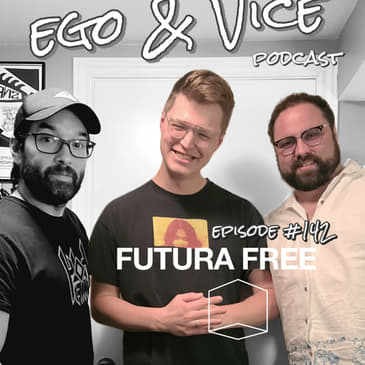
Drawing from their punk roots, Futura Free brings energy, noise and excitement to new heights in every performance. The band is always masterfully fusing elements from a myriad of genres; from catchy indie-rock hooks to the experimental backdrops of noise music, and the sombre musicality of midwest emo. This band is one to get familiar with if you are looking for just a bit more nuance and ear candy incorporated into your feel-good jams (without getting too serious about it all). "Kingston Rocks"
https://linktr.ee/futurafree
Egoandvicepodcast.com
E&V
[00:00:00] It's really early in the morning and I realize I have to release this podcast tomorrow
[00:00:07] and I haven't even looked at it.
[00:00:10] So I'm editing it early before work.
[00:00:12] I'm tired. Ego and Vice.
[00:00:16] You got a real attitude problem, McFly, you're a slacker!
[00:00:37] I'm drinking with my mates, just to be in for a ride.
[00:00:48] Then I hit the teen years ago and they're seeing me hanging around.
[00:01:23] Good morning! This is Mike. This is Ego and Vice, Episode 142. Thanks for coming back.
[00:01:30] Yes it is morning and I'm just enjoying my first cup of coffee as I sit and I edit this fine podcast.
[00:01:36] Let me just have a sip, hang on.
[00:01:40] Oh that's good. You know what? I'm going against the rules that I always tell everybody.
[00:01:44] I have this pet peeve of eating, drinking, chewing gum, anything like that on a microphone like a podcast drives me crazy.
[00:01:54] And I just broke my own rule. But you know what? It's morning.
[00:01:58] It's a brand new day. Anything can happen.
[00:02:01] The world will unfold as it shall. As it must.
[00:02:07] And I'm probably half asleep, that's why I'm rambling on.
[00:02:09] Anyway, on the podcast this week I had two members of the local band Future Afri.
[00:02:17] I had Peter and I had Clinton. They came into Southwood Studio and we sat down and we talked all about the band.
[00:02:24] And we had a great conversation about songwriting because if one thing Future Afri has a lot of its songs.
[00:02:34] And I find that fascinating. I find songwriting fascinating. I could talk about it all day.
[00:02:40] I love it and I love sitting down and talking about people who, with people who love it as well.
[00:02:46] And I also picked their brains for tips and hints and strategies to get me through my extended concrete like writer's block that happens in my brain.
[00:02:57] So cool. Yeah, let's get to it. I don't have a lot to say today.
[00:03:05] Maybe when I actually wake up and my meds kick in. I won't be so scattered and thinking of other things.
[00:03:12] So while you got me, let's introduce this is a song from Future Afri. It's called The Current.
[00:03:19] And after that we'll come back with Peter and Clinton right here on Eagle and Vice.
[00:03:27] I'm a little bit of a poor. Watching the storm rolling. I guess this is really it.
[00:03:36] I'm awake on a bus or in a coffee shop or maybe just driving around.
[00:03:45] These things aren't real. I haven't left the house. The water's high and it's rising fast.
[00:03:51] The only thing left to do is ask. Did we ever make a difference? Could we ever change our fate?
[00:04:01] The choice of where we're heading was never ours to make.
[00:04:06] Well watch it slip through our fingers. Watch the way in the end.
[00:04:13] Just know that I was always proud to be your friend.
[00:04:36] Places, impossible doors.
[00:04:40] Who was I a year ago?
[00:04:43] What does it mean if I don't know?
[00:04:46] Am I alive or just a projection?
[00:04:52] Or somebody in between?
[00:04:55] I won't look in the mirror this is just a dream.
[00:04:58] I'm not prepared but it's time to go.
[00:05:01] I'm not upset. I just want to know.
[00:05:04] Did we ever make a difference? Could we ever change our fate?
[00:05:11] The choice of where we're heading was never ours to make.
[00:05:16] Well watch it slip through our fingers. Watch the way in the end.
[00:05:23] Just know that I was always proud to be your friend.
[00:07:42] I wasn't upset. And we're all the current of it.
[00:07:51] I don't know the reason. I'm this one.
[00:08:02] Hey welcome back. This is Ego and Vice Episode 142.
[00:08:10] As promised in the intro, I have two members of the local band Futura Free.
[00:08:15] Hello, I have Peter and I have Clinton.
[00:08:19] What's going on?
[00:08:19] Thank you so much for coming out to Sothoode Studio.
[00:08:26] And meeting the Sothoode Studio mascot, the one the only, the cat.
[00:08:32] Hello Thomas. He's perfect in every way.
[00:08:34] Absolutely. So why don't you guys introduce yourselves and let the world know who you are, what you play, what you do?
[00:08:43] Alright, my name is Peter. I play guitar and I sing in Futura Free.
[00:08:50] I'm Clinton. I play bass and I do backup vocals in Futura Free.
[00:08:53] Okay this might blend into the future conversation that we're going to have.
[00:09:00] I usually ask a question, just a random question at the beginning.
[00:09:05] In your opinion, who do you think of like out there bands that are out there?
[00:09:09] Who do you think has the biggest song catalog?
[00:09:12] Like of every artist ever.
[00:09:16] What about, has anyone heard of Buckethead before? He's like an experimental guitar player.
[00:09:23] I remember I went down like a Wikipedia rabbit hole. He like releases like four albums a year or something like that.
[00:09:30] That's not a very, I don't really listen to Buckethead.
[00:09:33] Do the Beatles have a big big catalog?
[00:09:36] But I don't know if they can beat some of these. Even like some band camp or SoundCloud electronic producers I know are like pumping stuff out.
[00:09:45] But I don't know if we're going for full songs, full release. I think Buckethead is probably a pretty good pull there.
[00:09:52] I remember he was like in Guitar Hero or something that was kind of my introduction then.
[00:09:57] Anyway, I don't know. Yeah, Buckethead.
[00:09:59] Final answer.
[00:10:00] That's cool. Buckethead was, didn't he play in like Guns N' Roses for a while?
[00:10:05] Buckethead wears the KFC bucket on his head with the white kind of mime mask.
[00:10:12] Okay, the reason I ask this is because doing my deep dive research on Future Free,
[00:10:20] not counting acoustic releases of songs and electronic songs,
[00:10:27] you have 88 songs approximately. That's what I could find listed.
[00:10:33] So big time writers.
[00:10:38] Yeah, I think the secret is that we record everything ourselves.
[00:10:44] So when you take kind of budget out of the equation,
[00:10:49] I think you sort of end up, you know, you're less likely to just like cut something for time or money.
[00:10:57] And also when you're your own producer, I feel like maybe you don't have someone telling you to maybe trim it down.
[00:11:03] So you wind up with a lot of material that just gets released.
[00:11:07] There's an entire project in there where you released one song a week for the entirety of pandemic.
[00:11:14] Which really bolsters numbers in a way that maybe without a pandemic wouldn't have happened.
[00:11:21] But it was very cool.
[00:11:23] Yeah, that particular project was sort of a, just you know, without anything else to do,
[00:11:29] it was fun to just keep releasing music for the heck of it I suppose.
[00:11:33] There's a good argument out there where it's what do you prefer?
[00:11:37] What do you think is more effective to release a single or to release like an EP or to release like an actual record with like 12 songs?
[00:11:45] And I always thought it was kind of by choice and sometimes it is because, you know, you can bombard people with music.
[00:11:51] Here's my 12 songs, the 14 song, you know, LP or whatever you want to call it, you know, and they get through a couple of them.
[00:11:58] And then they kind of, whatever.
[00:11:59] But you put so much love and work and everything like into all the songs and then you have the single which you can kind of put out individually.
[00:12:06] And what I found out over the conversations of having this podcast, which ties into what you were saying,
[00:12:11] you make your own music, you produce it, you record it, you release it.
[00:12:15] A lot of these bands they can't.
[00:12:17] A lot of it, the reason they release singles is sheer cost.
[00:12:21] So you've eliminated that completely.
[00:12:23] Yeah. And like you said, I think that kind of, I love doing that.
[00:12:28] That's definitely my preferred way of making music and putting it out into the world.
[00:12:33] I definitely think it sometimes works to my detriment.
[00:12:37] Speaking as, you know, we having we just released a full length record and I love it so much.
[00:12:43] But I will say that a full length record is maybe not in the current day and age the most effective way to share your music.
[00:12:52] Yeah. I still, you know, Clinton and I are big like album heads.
[00:12:55] We still consume music like buy the album.
[00:12:58] But I can appreciate that that is maybe not the way that things are most commonly done anymore.
[00:13:04] Yeah. So it goes both ways. I appreciate that too.
[00:13:06] Like I come from an era where you would go to the store and you would purchase like a CD or a record and you got home and you unwrapped it.
[00:13:14] And as you were listening to it, you'd read the lyrics and the liners and stuff.
[00:13:18] It was the actual physical kind of like all the experiences.
[00:13:21] And it was wonderful, you know, and it's a shame that a lot of people don't haven't experienced that.
[00:13:26] I've had people in the podcast where one of my questions at the end is like, what was the first CD or record you've ever bought?
[00:13:32] And they'd be like, oh, I've never actually bought physical music before.
[00:13:36] And I'm just like, I check myself.
[00:13:38] I'm like, wait, I look at my watch and I'm like, how old am I?
[00:13:43] Where am I? What's going on?
[00:13:44] But yeah, yeah. And it's just, I think I like the full records too because that's the way the artists wrote them.
[00:13:51] That's the way it sequenced on there.
[00:13:53] Yeah. That's the way they wanted to release it, right?
[00:13:56] And there's a bit of like a magic or an art to the laying out of a record as well that like singles are great and you can sit down and listen to a single, but it's only a couple minutes, four minutes of music.
[00:14:08] You can tie that into a bigger narrative being said.
[00:14:11] There are concept albums, albums that are stories front to back.
[00:14:15] So I'm here.
[00:14:16] I've discussed this at length drunk on the couch before, but sometimes a good album plays out like a movie and singles play out like a movie.
[00:14:26] Like a scene from the movie or like songs on the album play out like scenes from the movie.
[00:14:31] That's so you can have a scene that you'd want to go back and rewatch on YouTube over and over again, but some of the better albums like the full experience is to sit down and listen to it front to back.
[00:14:40] I completely, I completely agree with that.
[00:14:42] Not everything needs to be a concept album, but usually stuff is written in the same kind of timeframe.
[00:14:50] You know what I mean?
[00:14:50] You know when bands first get together and you don't really have much songs, but he has a song and he has a song and he has, they are written in different parts of the world by different people at different times.
[00:14:58] And you put them together and they all fit on a record, but it's just like, yeah, it's a bunch of nice songs.
[00:15:03] And then you finally down the road, you write a record together and it's like, okay, this is what this is all starting to sound like that this band now.
[00:15:11] So I like the idea of like a full record because it's all written in the timeframe.
[00:15:15] You kind of get that moment in time.
[00:15:18] You know, you listen to a song and you get that nostalgia.
[00:15:19] It's like, oh yeah, it reminds me of that.
[00:15:21] And it might just be the atmosphere of the record itself for the songs.
[00:15:25] Yeah. So very, very, very cool.
[00:15:27] And I listed a whole shitload of singles and EPs and LPs which we can get to and we can kind of pick through.
[00:15:33] But why don't we start at the beginning?
[00:15:35] Why don't we start with the origin story maybe of the band or even individual?
[00:15:41] Peter.
[00:15:42] Yeah. This is a good one.
[00:15:45] So I'm from Thunder Bay, Ontario originally.
[00:15:49] I know. I looked at what I, yeah.
[00:15:51] Sorry, I didn't mean to yell.
[00:15:52] I didn't mean to yell.
[00:15:53] Yeah. So I'm from Thunder Bay, Ontario originally and Clinton and I met at the University in Thunder Bay.
[00:16:00] Clinton is from Lake Hedew.
[00:16:01] Yeah. So Clinton and I met there and started a band called the soapboxer.
[00:16:09] And that was sort of a, I refer to it as sort of a proto future of free.
[00:16:13] It was kind of, you know, if you go back and listen to it, it's pretty clear like, you know, the intention is kind of there with the band.
[00:16:19] So anyway, we just kind of wrote music together.
[00:16:22] We really bonded over like similar artists and stuff.
[00:16:24] So we played in this band.
[00:16:27] And then after graduation, we, Clinton went, sorry, and I'm kind of telling your side of the story, but Clinton went to Windsor and I ended up moving to Kingston with my girlfriend at the time, now wife.
[00:16:42] But so yeah, we moved to Kingston and then I kind of just put up a Kajiji ad saying, hey, like I play music.
[00:16:48] I don't really know anyone in this new city. If anyone would like to hang out and play music and sort of from that Kajiji ad, I was able to sort of meet some guys who formed the band.
[00:16:58] And then Clinton, we both ended up in Ottawa after that's and from there, Clinton jumped into the band.
[00:17:06] And yeah, so that's sort of, yeah, sort of my side of things there.
[00:17:09] Very cool. Very cool. Clinton.
[00:17:11] Yeah, I don't have much to add.
[00:17:12] I started my own solo project outside of that when I lived in Windsor called Head Glow.
[00:17:19] But moving back to Ottawa, I moved to Windsor originally for work.
[00:17:22] You know, you graduate from university and you're trying to find that money, trying to find a place to live.
[00:17:28] And that sucked.
[00:17:30] I met a lot of good friends, but I really didn't like it.
[00:17:32] So I decided to move where my friends were going to go and Peter and I had always been very, very close.
[00:17:37] I used to travel from like Kingston to Windsor at like seven hour run just to hang out.
[00:17:41] So I'm like, well, Peter and Heather are moving to Ottawa.
[00:17:43] I'm going to go there as well. And Peter approached me to join the band.
[00:17:46] It's been great ever since.
[00:17:48] I really like the way Peter approaches songwriting.
[00:17:51] And it leaves a lot of really fun space for me as a basis to like really lock down the groove.
[00:17:57] The guitar is a lot more textural and a lot less rhythmic in future,
[00:18:01] which allows the bass to really step into that role even stronger than in some other bands.
[00:18:05] And the fact that we've been in a band before meant it was just sort of you're able to catch the ground running.
[00:18:11] Peter had a whole bunch of songs, learn them, jump in, bada bing, bada boom.
[00:18:15] Cool, cool, cool.
[00:18:18] Thunder Bay, that's crazy.
[00:18:19] I meet a lot of people from Thunder Bay.
[00:18:22] There hasn't been many that have been down in the studio except me.
[00:18:29] I find there's two types of people in Thunder Bay.
[00:18:31] There's ones that move, okay, there's three types.
[00:18:33] There's ones that stay in Thunder Bay and never leave.
[00:18:37] There's ones that live and die by moving like west.
[00:18:41] Sometimes they come back and then there's the east folk.
[00:18:46] And were you born in Thunder Bay?
[00:18:47] I was.
[00:18:48] You were born, how was born? You weren't born in Thunder Bay.
[00:18:50] No, I just went up for school.
[00:18:51] Okay, school, school, school.
[00:18:52] What was the outpost?
[00:18:54] Is that what it was called?
[00:18:55] Yeah, we still call that.
[00:18:57] We've played at the outpost to basically no one before, but it was lots of fun.
[00:19:03] It's huge, it's very strangely large.
[00:19:06] Yes, yes.
[00:19:08] I have a video tape which I actually had transferred to like a USB stick of my old band.
[00:19:14] I had a band in Thunder Bay called I Refuse and we played the outpost.
[00:19:18] Do you remember Meat Had Records?
[00:19:19] Probably not.
[00:19:21] I might have a few years on you.
[00:19:25] But yeah, yeah, I remember the outpost.
[00:19:27] We were just like a three-piece punk band and we were on this giant stage
[00:19:29] and we just stood there like statues.
[00:19:31] We were overwhelmed by like, oh my God.
[00:19:34] Is this Wimbledon Stadium?
[00:19:36] Yeah.
[00:19:37] With that like mural of famous artists hanging over your head watching your every move.
[00:19:41] Yeah, it's crazy, crazy, crazy.
[00:19:43] Thunder Bay was a fun place to grow up until I hit a certain age in my late teens, early 20s, that
[00:19:51] where I was just like, I need to do something different with my life.
[00:19:55] And my goal was always to leave Thunder Bay.
[00:19:57] I had friends and my sister who was an Ottawa and I was always going to,
[00:20:00] Ottawa was supposed to be a stopover to Toronto because I was going to follow my dreams
[00:20:05] and become like a band, something or a musician or working musician.
[00:20:09] You know, you know the goals.
[00:20:12] And you grow roots pretty quick wherever you land and if you're not careful,
[00:20:16] those roots get deeper and deeper and deeper and I ended up,
[00:20:18] I've never left Ottawa, I've been here ever since.
[00:20:20] But Ottawa was my home and it has a wonderful music community.
[00:20:27] A lot of amazing talents, a lot of amazing bands.
[00:20:29] It's a shame that it's, everyone who's an Ottawa kind of knows who we are.
[00:20:35] It's other people like outside of Ottawa that is hard to kind of bring in, right?
[00:20:40] So since you've been playing around Ottawa, when did the band actually get together?
[00:20:46] What era? Like I have around 2018.
[00:20:49] Yeah, that's correct.
[00:20:50] So 2018 was actually very similarly ready to leave Thunder Bay and move to the,
[00:20:57] well, not even the big city, Kingston is roughly the same size as Thunder Bay.
[00:21:00] But I was ready for a change, I think.
[00:21:02] So yeah, 2018 was basically when the Kijijiad went up where people who responded joined the band.
[00:21:09] And so yeah, 2018 would be when the band got started and then I would say 2022 was when we both moved.
[00:21:17] Clinton and I both ended up in Ottawa and that's when Clinton joined the band
[00:21:21] and this like sort of iteration of the band came into being was 2020.
[00:21:24] Our Ottawa era, if you will.
[00:21:27] And there's four of you in the band, right?
[00:21:29] Did you want to give a shout out to the other two guys, maybe introduce them as well?
[00:21:33] The other two members, I mean?
[00:21:35] I would love to. On drums we have Bobby Benavidez. He's been there since day one.
[00:21:40] He was one of the Kijiji responders.
[00:21:43] A tremendous, tremendous drummer, tremendous guy.
[00:21:45] Tremendous name.
[00:21:46] Yeah, Bobby Benavidez.
[00:21:48] And then on guitar we have Jorge Moreno and he just joined this year.
[00:21:55] And he's been a tremendous delight to work with and yeah, just a fantastic guitarist
[00:22:01] and a very handsome man as well.
[00:22:02] So that's him.
[00:22:04] He's a handsome man.
[00:22:06] Since 2018, since we're in that start, I go through singles and APs in between 2018,
[00:22:16] January 19, April 19, January 20, these are years like the year 2020, April 2020.
[00:22:22] You release science fiction, cascade.
[00:22:26] Be careful what you get good at which was a long time.
[00:22:28] I like that one. That's an underrated. That's my yeah.
[00:22:33] Stranger, thrown from a bridge.
[00:22:35] Yeah, that's cool.
[00:22:36] Mantis creature, breakfast at Mike's.
[00:22:40] What'd you have?
[00:22:41] I don't, that was, that's just a joke that I, one of my friends' dads was named Mike
[00:22:45] so when I would be at his house I guess probably we had waffles or something.
[00:22:49] Very good.
[00:22:49] A friend, do you know an area resident in town?
[00:22:53] His name's Doug Hempstead.
[00:22:55] I don't think so.
[00:22:56] Anyway, he just posted something on social media today.
[00:22:58] He was eating a bowl of Frankenberry and he's like the best thing about being an adult is no one can stop you from eating this sugary garbage.
[00:23:05] Anyway, it just reminded me of the breakfast.
[00:23:07] Move on to October 2020.
[00:23:09] You put out Putrash where it belongs.
[00:23:12] These are still singles and APs.
[00:23:14] April 21 was weapon May 20, 21, pardon me, was different things.
[00:23:19] May 20, 2022.
[00:23:22] Shock Goth volume one.
[00:23:24] I haven't seen a volume two yet.
[00:23:27] May 20, 2024 which is not too long ago gifted a wasteland and easy.
[00:23:32] It's like a split thing.
[00:23:34] Or just like two songs.
[00:23:35] Two songs.
[00:23:36] And just to get through them because I've started.
[00:23:41] These are the actual records that you've released.
[00:23:45] 29, oh sorry.
[00:23:48] Yeah.
[00:23:50] 2019 you had Unreal.
[00:23:53] Correct.
[00:23:53] Then you had Unreal Acoustic.
[00:23:55] And then you had Reveal released a song every week during quarantine.
[00:23:59] Which was I think, how many songs was it?
[00:24:02] 19 because I always remember it was 19 because it wasn't 20.
[00:24:05] It wasn't the nice round number.
[00:24:06] It was 19.
[00:24:08] Pandemic could have lasted just one week longer.
[00:24:12] June 21, Reducer.
[00:24:15] Then you had a deluxe version of Reducer with electronic versions.
[00:24:19] Yeah, that was fun.
[00:24:20] And then in 2024 you had this reality.
[00:24:27] Distant offer.
[00:24:29] Is that right?
[00:24:30] Distance.
[00:24:31] Distance over direction.
[00:24:34] Distance and direction over everything.
[00:24:36] That would just be another single.
[00:24:37] So yeah, this reality.
[00:24:38] Yeah, deciphering the notes.
[00:24:41] And that was the most recent stuff.
[00:24:44] How does the writing process work for something?
[00:24:48] When you have 88 songs that you must be writing all the time.
[00:24:52] Do you all write together or are they individual songs that are brought?
[00:24:56] Is there a primary writer?
[00:24:57] What's the secrets?
[00:24:59] It's mostly Peter.
[00:25:01] Some bands work great as a collaborative effort between many different people.
[00:25:05] But I remember watching, any basis will probably have seen Adam Neely videos on YouTube over their history of learning the bass and stuff.
[00:25:12] And he brought up something that I really like about, it just sometimes works better if there's a band leader.
[00:25:19] Someone with creative direction, someone to turn to for a decision so you don't get that fighting over stuff.
[00:25:26] What's the band? Who's the band?
[00:25:28] The classic thing that broke up a lot of bands in the 70s and 80s.
[00:25:32] So Peter has always been sort of the guiding directive for us with Future are Free.
[00:25:36] He does basically all the lyrics, most of the song writing.
[00:25:39] He brings us demos and we write our own parts to them.
[00:25:43] We can suggest edits, Peter and I sat down with our heads together to rearrange songs or edit things to be more concise.
[00:25:50] But the bones are there of the tune.
[00:25:53] I appreciate that.
[00:25:54] That's the way I can relate to that songwriting.
[00:25:58] I've never been in a band where all five or four of us got in a room with nothing and said let's write a song together.
[00:26:04] It just never really goes where you want it to, right?
[00:26:06] There always has to be started off with some sort of spark of idea.
[00:26:10] Like I said, the bones of something and then you kind of build from there, right?
[00:26:14] Have you always written, before you wrote songs, did you write novels?
[00:26:21] Yeah, I mean like not really.
[00:26:24] There's no way to say this without like, I've always considered myself, I don't know how to say this without sounding like a tool.
[00:26:31] I felt like pretty creative from a young age.
[00:26:33] Like I used to make home movies and stuff like that.
[00:26:36] I've always really been into video and film and stuff like that.
[00:26:40] I would write really lousy, occasionally.
[00:26:44] I was really into the Jason Bourne series when I was a kid so I probably tried to write some action story or something.
[00:26:50] Just garbage, you know?
[00:26:52] But I think music was the first thing where I probably dedicated enough time to it where I started feeling like I was actually okay at this.
[00:26:58] I'd say.
[00:27:00] And I guess technology is evolving right down your alley, right?
[00:27:06] You're able to do all this stuff when you were a little kid, you wanted to make movies and stuff or whatever and now you can.
[00:27:11] Yeah, exactly.
[00:27:13] It's been a real pleasure sort of being able to live in an era where the production of art is sort of democratized.
[00:27:23] You don't need a billion dollars and be financed by some production company or financed by a label to make an album or make a short film or something like that.
[00:27:33] I think there's a lot of spooky things about some technology, but I think there's a take for granted how good we have it in other ways.
[00:27:42] Yeah, it's like back in the day where it's like we got to get a record deal man else no one will hear you.
[00:27:47] That is just like, it's crazy to think about now.
[00:27:51] It's just like I'll just do it myself.
[00:27:53] Distribution still helps, but what do you prefer?
[00:27:57] The production side of music or playing live?
[00:28:01] I like both.
[00:28:02] Gun to my head probably production side of things.
[00:28:07] Although I do, I think we both love playing live.
[00:28:10] I've definitely worked with musicians before who love the writing and production process and just hate getting up on a stage.
[00:28:16] We're definitely not like that, but I think whenever I get burnt out from playing live, I get really into producing music and when I'm really burnt out from finishing a record or something, playing live is good.
[00:28:30] So it's a nice seesaw of just being able to like both.
[00:28:33] And that fits in really well with the natural cycle of you release an album, you want people to listen to it so you start gigging more.
[00:28:40] You gig on that album, you're probably sick of hearing the recorded versions and tweaking with them.
[00:28:46] So now you're back feet on the ground, you might not open your laptop for a while and then when you get kind of tired of that, well, it's probably been long enough that it's time to write a new album for new material for the people to listen to.
[00:29:01] Let's play a song.
[00:29:03] Cool.
[00:29:03] You have a lot of them. Would you like to choose one and introduce it?
[00:29:08] Sure.
[00:29:12] I'm really drawn up like let's do distance and direction off the new record.
[00:29:17] This is distance and direction by Future of Free.
[00:29:20] Ego and Vice.
[00:30:22] No.
[00:31:17] Oh.
[00:31:39] Oh.
[00:31:43] Oh.
[00:33:14] So when you create set lists and you have 88 songs what do you choose?
[00:33:23] Are they just always different or do you have like a base chunk of songs?
[00:33:28] The hits, do you just play the hits?
[00:33:29] We just play it, we got a base chunk of songs.
[00:33:31] We're actually pretty, we probably stand to be a little more adventurous with set lists I think.
[00:33:36] It's kind of what everyone's used to and what everyone's like really locked into.
[00:33:39] Lately it has been like pretty much everything off the new record.
[00:33:43] Just as a matter of like, ah, like, you know, we played these songs so much to get ready to record them in like pre-production that we said,
[00:33:51] well like we're really locked in with all these songs.
[00:33:53] Like, you know, we certainly don't remember how to play every single one.
[00:33:57] Like some of these are kind of, there's been weird overlaps with like who knows what material and stuff like that.
[00:34:03] So I think it's mostly, you know, for despite the large catalog, I think it's like a fairly like streamlined, you know,
[00:34:09] catalog of what we're going to be doing live.
[00:34:11] So if you're a fan of the band, if you see two different times and two different things, you'll hear some of your favorites.
[00:34:21] Yeah, pretty comparable stuff I think we have a, yeah.
[00:34:23] Do you have songs that you've never played live?
[00:34:25] Yeah, a lot I think.
[00:34:27] A lot of what was released in that sort of, we released a song every week during quarantine.
[00:34:36] Those songs were almost even more like kind of like recording experiments.
[00:34:38] Like a lot of it, like some of them were like, you know, get everyone together and like work on something.
[00:34:43] But I think much more often it was like an idea or something that sort of just got embellished like in the studio.
[00:34:50] I've actually always been a real advocate for like, you know, there's a time and place to like record music that like has to translate live.
[00:34:57] But I've also enjoyed experimenting with music that like, oh, like well, it doesn't need to be played live.
[00:35:01] It can just be like whatever, like it can be add an instrument that we might not have access to live or something like that.
[00:35:07] So anyway, how did you choose your set out of having so many songs?
[00:35:13] Was there ones that actually stood out or you just decided to make the set?
[00:35:19] I think it was, we definitely gravitate towards the songs that are like, I think upbeat.
[00:35:24] Like I don't think there's a lot of interest in doing like a weird slow slog like song or anything like that.
[00:35:32] I think and yeah, once again, like the new stuff and like the old stuff that we bring in is kind of like the upbeat, like the hits, the hits from that particular album.
[00:35:41] So you know, the kind of classic like, you know, you cycle in all the new stuff, but you bring it back all the old ones from the old records that people responded to more positively, I think.
[00:35:49] Yeah, sometimes it works out. We all learn like before the album is out or even recorded sometimes, Peter's feeding in one, two, maybe three new songs to learn.
[00:36:00] We gig them for a while. Oh, we have a whole album's worth of material. It's studio time to record it.
[00:36:06] Those are the songs we know. So now our set list is almost entirely the new album to go along with the album release.
[00:36:12] And then every once in a while like someone in the band is like, I really love this song from an old record.
[00:36:17] We've like, we'll throw that back in. There's quite a bit of, you know, and Bobby's our drummer.
[00:36:22] He lays it down. So if Bobby wants to play a song, we try to try to honor that too because that's a man you want to keep happy.
[00:36:28] Bobby gets his way. What's his last name again? Benavidez. Bobby Benavidez on the drums. What a name. That's a great name.
[00:36:36] I just call him his full name every time I say it. But Peter does when he announces him at every show because it's just so fun to say.
[00:36:44] I think I have probably give or take maybe about finished from my years of whatever, but I probably have about 500 half songs.
[00:36:54] How many half songs do you would you approximate that you started, loved and then just never finished?
[00:37:00] It might be less than you think, which that sort of goes back to your finisher.
[00:37:05] Well, he's a closer. Clothes for clothes.
[00:37:10] It's because of that silly COVID project of the song every week.
[00:37:15] Those were a bunch of half finished songs.
[00:37:17] And it was kind of like, OK, I just want to, for the sake of releasing something as sort of a writing exercise or a production exercise.
[00:37:26] So I sort of was functionally taking a broom and all these half songs on my hard drive or whatever, just an idea recorded.
[00:37:34] They got turned into full songs.
[00:37:36] Now I think I'm starting to accumulate a bit of a backlog of half finished songs, but not as much as you might think.
[00:37:43] I don't know why that is. Maybe my writing style is changing or something, but yeah.
[00:37:49] Or maybe you're getting closer to the product that you want to actually record quicker or like.
[00:37:59] For me, songwriting is difficult because my attention span is bad.
[00:38:07] I'm pharmaceutical medicated for my poor, poor attention span since I was a child.
[00:38:12] But I'll start something and it'll get really good.
[00:38:14] And I'll be like, oh wow. And then I'll just like, I hate this. I hate it.
[00:38:18] And I'll put it down and I'll listen to it again and I'll be like, I don't feel it anymore.
[00:38:22] So I have so many, so many half songs.
[00:38:24] But what I started to do, like what you said was just like close the coffees for closers.
[00:38:29] Fuck you! That's my name.
[00:38:32] I recently just finished an EP.
[00:38:36] I just labeled it Mikey No One because it sounded kind of cooler than Anonymous.
[00:38:41] And it's basically just half songs, you know where you just start and say you only have like just a little verse and kind of a catchy chorus.
[00:38:48] Or normally I would sit there and I would just pound on the clay until it's one big lump of...
[00:38:54] And then I can't shape it to where I want it so I just kind of leave it alone.
[00:38:57] I just take those two little pieces, put it together, repeat, and that's the song.
[00:39:01] And it was the most liberating freeing project I've ever done.
[00:39:07] I did seven songs in like a week.
[00:39:08] Nice.
[00:39:10] And I just recorded it myself and released it.
[00:39:11] And it was wonderful.
[00:39:12] And I'm trying to do it again but now I'm overthinking it.
[00:39:15] Yeah.
[00:39:17] I've told Clinton, this will sound familiar to Clinton,
[00:39:20] we're both very big fans of an artist called Jeff Rosenstock.
[00:39:24] And I remember this happened probably, this was back in the Thunder Bay days when we were playing in that last band.
[00:39:31] And I remember Jeff Rosenstock was like answering some questions on Reddit and someone asked him,
[00:39:35] hey Jeff, I'm sort of writing or recording something and it's sort of almost there.
[00:39:42] But how do I know when it's done?
[00:39:44] And Jeff's response to that question lives rent free in my head
[00:39:47] and I should get a tattooed on me or something because it's the most important piece of advice I think I ever heard.
[00:39:51] And it's just release it, get it out there, you get closure through the act of releasing this piece of music,
[00:39:57] you get closure on it, you can move on, learn.
[00:39:59] And then you can learn from what you liked and what you didn't like.
[00:40:01] But once you release a piece of music, you're sort of locking it in and committing to what that is.
[00:40:07] And I think that sort of informed a lot of the extensive catalog of like,
[00:40:13] okay, well this is done and I just want to release it and take away what I liked and what I didn't like
[00:40:19] and what I liked and did not like about that piece of music and sort of go on from there.
[00:40:23] I think that was a question that just popped into my brain too, is do you like your music?
[00:40:27] Do you like the stuff you write?
[00:40:28] Yeah, probably too much actually.
[00:40:33] Until it comes up on a playlist of the party.
[00:40:35] Then I get embarrassed.
[00:40:37] But yeah, it reminds me of, I don't remember a famous artist but of course now quotes,
[00:40:43] I can't remember who said it but there's a very famous quote about like,
[00:40:46] no art is ever finished, only abandoned because you could nitpick, you could redo sections,
[00:40:51] you could do whatever you want forever and music with releasing as opposed to a painting
[00:40:56] where you just have to like hand it to someone or hang it on a wall and be done with it.
[00:41:00] Music there's like a whole process you can do that's a separate line in the sand
[00:41:04] where you can't touch it anymore, it's out in the world.
[00:41:08] You could do a remaster, you could do a re-edit, you could re-record it
[00:41:11] but a version is done that people can listen to sort of a definitive,
[00:41:15] you let it go.
[00:41:17] It might not be finished but you like let it go.
[00:41:21] Exactly, exactly.
[00:41:23] I think that can be very cathartic.
[00:41:24] Yeah and after that much writing, I love talking songwriting by the way.
[00:41:29] This is one of my things.
[00:41:30] What do you, I found the older I get the harder it is for me to write lyrics.
[00:41:35] When I was younger I used to just kind of snarl out, I was always kind of a rock punk rock guy.
[00:41:39] So it's very easy when you're young and angry to write lyrics.
[00:41:42] For me as I'm getting older, I'm pretty happy guy, everything's good.
[00:41:46] I'm not like, fuck you dad, I'm not that guy anymore so I find it hard to write lyrics.
[00:41:51] What are your songs about?
[00:41:55] Anyway, that's a really good question and I think, Clint, I have different answers to that.
[00:41:59] I feel very seen because I mentioned having a solo project and I'm sitting on a whole bunch of,
[00:42:04] typically my songwriting style is sitting down with an acoustic guitar typically,
[00:42:09] chord progression and humming a bit of a melody and then words.
[00:42:13] Like lyrics really inform that I might change the harmony to match like the melody that I've written
[00:42:18] but words typically came first for all of my previous writing
[00:42:22] and then all of a sudden my life got quite a bit better.
[00:42:26] I was hanging out with friends, I was doing the things that I wanted to do.
[00:42:29] It's hard to write songs, it's hard to write at least like darker indie rock or emo songs
[00:42:34] about having a good time where as like I can probably write like, yeah,
[00:42:38] I could write like probably some like like dancey stuff or some upbeat stuff
[00:42:41] but the stuff that really hits me in my soul is typically a little bit darker or moodier
[00:42:45] and that's become really hard for me to write because I still,
[00:42:51] that's still what I want to hear and still what I want to write
[00:42:53] but it's not really where my life is anymore.
[00:42:55] So I'm encountering that same problem where I've been sitting on about an album's worth of material
[00:43:01] that I just don't know what lyrics to put to it
[00:43:04] and then my life's been all over the place too.
[00:43:06] I moved and I moved again and joined a different, I joined Future Freeback
[00:43:10] so I've had like other priorities but I do want to get back into it
[00:43:13] but I totally understand the struggle of what to write
[00:43:17] and whether it's good enough, whether it's better than the stuff I've written before
[00:43:21] but an author that I really like once said like,
[00:43:25] most of writing happens in editing not in writing
[00:43:29] and you can't edit a blank page.
[00:43:32] If you have an idea, you have to write it down,
[00:43:35] it could be the stupidest sounding thing.
[00:43:36] Once you can see it, the dumb thing written out,
[00:43:39] you can see what merits it might have, how you would change the words
[00:43:42] but you can't edit a blank page.
[00:43:44] That's brilliant because that's the way it happens.
[00:43:46] Like I'll phonetically blah blah blah something down
[00:43:49] and then I'll listen to it in the car or something
[00:43:50] and I'll just kind of this line will come into my head
[00:43:53] that's over top of that one, a race, and you put it in,
[00:43:56] you put it in after, cool, yeah.
[00:43:57] So I totally agree with that, just write anything down.
[00:44:00] And the sky was full of poo
[00:44:02] because it won't stay that way
[00:44:04] but at least it's there and you can change it.
[00:44:07] Be angry enough at it to change it later.
[00:44:09] I hate that line.
[00:44:11] Yeah, and then when you think of it like,
[00:44:12] what was the sky actually full of?
[00:44:14] You wouldn't have thought of that in the moment
[00:44:15] but now you're writing a song about maybe a day
[00:44:18] that the skies looked crazy or whatever.
[00:44:22] Yeah, yeah.
[00:44:22] And I find too, the older I get
[00:44:25] and the more music I've listened to
[00:44:26] and the more I've just consumed,
[00:44:28] especially with the internet now
[00:44:29] where it's just so easy to just,
[00:44:31] it's everything you ever wanted to listen to
[00:44:33] for 1399 a month, you know what I mean?
[00:44:34] And it's just like when I'm writing,
[00:44:36] it's like I've heard this before,
[00:44:38] nobody wants to hear that shit.
[00:44:40] Oh, this has been done a thousand times.
[00:44:42] You have to kind of let that go too
[00:44:43] because it all has been done a thousand times,
[00:44:46] a million times.
[00:44:47] And if you're saying something that
[00:44:50] everyone's been through and you hate,
[00:44:51] you know what I mean?
[00:44:52] As writing it, it doesn't mean
[00:44:54] it's not gonna relate to something, to something.
[00:44:56] At least it's truthful too, right?
[00:44:58] It's also written through the lens
[00:45:00] of the way that you write.
[00:45:01] Everyone has their own style.
[00:45:02] Everyone has their own art style.
[00:45:04] Everyone has their own voice
[00:45:05] because you're speaking from...
[00:45:06] So the way you choose to say things
[00:45:08] and the phrases you put together,
[00:45:10] whether those phrases have been heard before
[00:45:11] or the message of the song has,
[00:45:13] it's still from your perspective,
[00:45:15] someone might still pick up on like,
[00:45:16] I like the way this guy says things
[00:45:17] or the way this guy's flow is
[00:45:19] or the words this guy chooses to use
[00:45:21] to express it.
[00:45:22] But anyway, sorry, I think Peter,
[00:45:23] you maybe had a different outlook
[00:45:25] on the writing process
[00:45:28] and the getting older
[00:45:29] and what you write songs about
[00:45:30] that I didn't want to just trample over.
[00:45:33] Oh no, I just...
[00:45:34] I write songs, so I feel the exact same way
[00:45:36] as both of you guys were like,
[00:45:38] I write songs about, you know...
[00:45:40] Well, I should say I write songs
[00:45:41] about what distresses me
[00:45:42] and when I was younger
[00:45:44] I was distressed about very...
[00:45:46] You know, your classic relationship things
[00:45:48] or heartbreak or whatever.
[00:45:50] I've been fortunate enough to not
[00:45:52] have those things really be a common
[00:45:54] place in my life
[00:45:55] as I've been getting older.
[00:45:56] So I've been turning to
[00:45:59] thematically writing about
[00:46:01] sort of the world outside
[00:46:03] how things are getting really bleak outside.
[00:46:05] That kind of falls in with like
[00:46:07] environmental dread and stuff like that.
[00:46:09] The new album is...
[00:46:10] Well, I wouldn't say...
[00:46:11] Well actually, I would say the new album's political.
[00:46:13] I would argue that all art is political.
[00:46:14] But it's not specifically about...
[00:46:17] Like it's not as topical.
[00:46:19] Yeah, it's not as like...
[00:46:20] Yeah, it's only topical
[00:46:21] in that sort of vague,
[00:46:23] uneasy sense you get
[00:46:24] when you look around you
[00:46:26] and see all the nasty shit
[00:46:28] that's happening.
[00:46:29] So that's kind of the narrative throughline
[00:46:31] or sort of the thing that sort of holds together
[00:46:33] a lot of the lyrics on this new project
[00:46:35] that we just released.
[00:46:37] But yeah, I write about what worries me
[00:46:39] in the past.
[00:46:40] It's been about mental illness.
[00:46:42] I'm lucky enough that I'm doing better in that regard.
[00:46:44] But you know,
[00:46:45] what's worrying me right now
[00:46:46] is sort of the state of the world
[00:46:47] and stuff like that.
[00:46:48] Yeah, it's crazy.
[00:46:50] Everything's crazy.
[00:46:51] This is not a political podcast.
[00:46:54] So we try to talk about
[00:46:55] the things that make us happy.
[00:46:58] If that's what your song's about,
[00:46:59] that's not like, you know, I'm not saying,
[00:47:01] don't talk about what your song's about.
[00:47:02] I'm just saying, you know,
[00:47:03] I've had political things come up
[00:47:05] and it's just like,
[00:47:06] back to music.
[00:47:08] Yeah, yeah.
[00:47:08] So no, I get that.
[00:47:09] I totally get that stuff
[00:47:10] that's going on around.
[00:47:12] That's the way I write now.
[00:47:13] It's just stuff that's in my window frame.
[00:47:16] You know, looking out the window type of thing
[00:47:17] or looking in the mirror type of stuff.
[00:47:19] I do a lot of introspective
[00:47:20] kind of how I feel about stuff now.
[00:47:22] I'm tired and I'm grumpy
[00:47:25] and I'm whatever, whatever, whatever.
[00:47:27] Stuff like that.
[00:47:27] Or why did this anyway?
[00:47:29] Well, it could also be good, like, therapeutic
[00:47:31] to stuff that's going on internally.
[00:47:35] One of the big things
[00:47:35] that a therapist might tell you
[00:47:37] is to write that stuff down,
[00:47:38] itemize it, list it out.
[00:47:40] That can be a great source of inspiration for,
[00:47:42] wow, I felt like, you know,
[00:47:43] this pain in my chest
[00:47:44] and this tightness
[00:47:45] and I was really worried
[00:47:46] about this thing happening to me.
[00:47:49] There's the bones of something that you could,
[00:47:51] whether not everybody wants to,
[00:47:53] you know, air their emotional
[00:47:55] mental health laundry
[00:47:57] on their music,
[00:47:58] but it can be a really gratifying
[00:48:00] even if it's first time you write for yourself.
[00:48:02] Yeah, no, that's true.
[00:48:04] It's cathartic.
[00:48:05] Yes.
[00:48:05] Right?
[00:48:06] Yeah, absolutely.
[00:48:07] Or you just needed, yeah,
[00:48:08] you just needed to get it out
[00:48:09] and people can interpret it any way they want
[00:48:11] provided you're not completely
[00:48:13] down the middle,
[00:48:15] direct about it, right?
[00:48:16] Yeah.
[00:48:16] And that's cool.
[00:48:17] And if I think creative people,
[00:48:18] they know how to build that.
[00:48:21] Yeah, absolutely.
[00:48:22] You know, where it's cathartic for them,
[00:48:23] but it's also kind of vague enough
[00:48:24] to put out in the world
[00:48:25] so you're not like hiding under your bed
[00:48:28] the next day, like, oh no.
[00:48:29] Yeah, yeah.
[00:48:30] So it's relatable to a stranger
[00:48:32] who might be able to take something from you.
[00:48:34] Yeah, exactly.
[00:48:35] Yeah, many a day of,
[00:48:37] it's that feeling where it's like you wake up,
[00:48:39] hung over and you kind of remember what you did
[00:48:41] and you go, oh no.
[00:48:44] Yeah.
[00:48:45] Anyway, but I don't know.
[00:48:47] I think any chance people can get
[00:48:50] to be creative, not everybody can write songs,
[00:48:52] but I think anybody can write something down,
[00:48:54] write stories, keep a journal.
[00:48:58] Write poetry, anything, you know,
[00:49:00] even just go to Michael's
[00:49:01] and get some canvas and some paints and draw circles.
[00:49:04] It's a release, it's getting something out of you
[00:49:07] and it's putting something into the world
[00:49:08] because we take and take and take as consumers
[00:49:11] and people put something out in the world
[00:49:12] even if no one sees it.
[00:49:14] Just get it out of you
[00:49:14] and I think that's great for any,
[00:49:17] good advice for anybody.
[00:49:18] Yeah.
[00:49:20] You can stop writing songs if you wanted to
[00:49:22] for a little while.
[00:49:23] Like you guys are good.
[00:49:24] I was about to say, oh well, you know,
[00:49:26] I'm taking a little break from songwriting,
[00:49:28] but that's actually a lie.
[00:49:29] I've been messing around with a bunch of folk music
[00:49:30] and stuff like that, so who knows what that's going to be,
[00:49:33] but it's not for a while.
[00:49:34] The other writer that has been in,
[00:49:37] do you know Teenage Fiction?
[00:49:38] Oh yeah, we love Sandy.
[00:49:41] We love Sandy.
[00:49:41] Sandy was here and he was flipping through his
[00:49:45] database, the Starship Enterprise dashboard.
[00:49:47] Yeah.
[00:49:48] Look at all the songs.
[00:49:49] He has so many songs.
[00:49:51] That doesn't surprise me that person.
[00:49:53] Yeah, he had like one file,
[00:49:55] he showed me like one file and there was like
[00:49:57] 150 finished songs in it.
[00:49:59] What a beast.
[00:50:00] He's like, yeah, I'll get down.
[00:50:02] I'm going to get to recording these sooner or later.
[00:50:04] I'm like, oh my Lord.
[00:50:05] But he does that too.
[00:50:06] He does his own production.
[00:50:07] Yeah.
[00:50:08] So he's really,
[00:50:09] he's also just one of the nicest people on the scene.
[00:50:11] The best.
[00:50:11] He's the best.
[00:50:13] Sandy's like, yeah,
[00:50:14] just can't say enough nice things about him.
[00:50:15] His production is tremendous.
[00:50:17] I've actually, I remember working on this record.
[00:50:18] I actually consulted him a little bit
[00:50:20] about his experience for some advice on a couple things.
[00:50:23] And his vocals are featured on one of the songs.
[00:50:26] Cool.
[00:50:26] There you go.
[00:50:27] Well, like the Ottawa community,
[00:50:30] there's a certain corner of it that just everybody knows everybody.
[00:50:33] And it's very, very cool.
[00:50:35] And everyone's really nice and very talented.
[00:50:37] And it's very strong right now.
[00:50:40] So I've seen Ottawa's music scene kind of go through
[00:50:44] peaks and valleys through the years, right?
[00:50:46] But right now we're in a really high point,
[00:50:48] which is cool.
[00:50:50] So what is the rest of 24 into 2025 look like for future free?
[00:50:58] Taking it pretty easy.
[00:51:01] I just chose, I think,
[00:51:02] trying to get, do a few more weekend runs,
[00:51:05] do a little more around Montreal and Toronto
[00:51:08] and Kingston and stuff like that.
[00:51:11] That's really about it.
[00:51:12] That's really the record.
[00:51:15] We sort of finished the record over,
[00:51:16] I guess I was finished in the winter.
[00:51:19] Anyway, it's been a lot of fun sort of, you know,
[00:51:22] getting that out there into the world.
[00:51:23] And I think I just playing around,
[00:51:25] probably more writing on the horizon at some points,
[00:51:28] although I'm not exactly rushing to do that either.
[00:51:32] But yeah, playing shows, hanging out, going to shows.
[00:51:36] I think that's the thing.
[00:51:37] I always forget that in the summer we're so busy
[00:51:41] that like I just love just being part of the community.
[00:51:44] Like it's not even us having to like play anything.
[00:51:46] It's just nice to go and hang out.
[00:51:47] It's not hard to find a show these days.
[00:51:49] There's always somebody playing somewhere
[00:51:51] and Ottawa has less venues now,
[00:51:55] but the venues that are there are kind of like the pillar venues.
[00:51:58] You'll see someone, Rainbow, Saw,
[00:52:03] Bronson Center has been pretty good for local guys,
[00:52:05] local people.
[00:52:05] I know Spectrasonic uses that place for bigger things,
[00:52:09] but at least there's like local openers and stuff.
[00:52:11] And the host of Targ, that type of stuff.
[00:52:14] Yeah, we love Targ.
[00:52:15] Yeah, Yogi just got married.
[00:52:17] I'm sorry, he just got married.
[00:52:18] I should have said congrats in my last e-mail too.
[00:52:20] Congrats.
[00:52:23] Do you have any, speaking of congrats,
[00:52:25] if you want to throw some out there,
[00:52:26] did you have any shout outs to any other bands,
[00:52:28] people, anyone you want to thank for this stage of your journey?
[00:52:34] We're going to begin. I don't know.
[00:52:36] That's...
[00:52:37] So many people.
[00:52:38] And that's why Peter is actually really good
[00:52:39] if you look at the liner notes of any of the future free releases.
[00:52:44] There's always a big give thanks section,
[00:52:46] and it's full of so many more people than your usual,
[00:52:50] like this is dedicated to my brother,
[00:52:52] or shout out to this one guy.
[00:52:55] And I'm sorry Peter, this may be awkward for you,
[00:52:58] but I've always found it seems very humble to say like,
[00:53:01] no thank you to my parents,
[00:53:03] thank you to all the people in this band,
[00:53:05] that band, that band,
[00:53:06] thank you to the people that I hang out with,
[00:53:08] like people that I party with.
[00:53:09] It's very honest to be like,
[00:53:11] your whole community, the whole village that raised you,
[00:53:14] all had some part in the thing that you did.
[00:53:18] But yeah, just shout out to the Ottawa scene,
[00:53:22] all of the bands.
[00:53:24] I'd never be able to have a comprehensive list,
[00:53:27] but Teenage Fiction, The New Hires,
[00:53:30] Class 91, Young Ghost House,
[00:53:32] just if you're out there and you know us,
[00:53:36] we're glad to have you in our lives
[00:53:37] and so happy to be your friends,
[00:53:39] be able to show up to a show.
[00:53:41] I just love it when I walk in
[00:53:42] and people now are like,
[00:53:43] hey Clinton how you been man?
[00:53:45] That does what no amount of therapy can do
[00:53:49] for my personal well-being.
[00:53:51] That's community, that's what that is.
[00:53:53] Exactly, it's a powerful thing.
[00:53:54] You're part of building it, you're part of it.
[00:53:56] So it's very good.
[00:53:58] Alright, I have a game that we play,
[00:54:00] it's called 13 Questions with the Band.
[00:54:03] Would you like to participate?
[00:54:05] Yes, we would love to.
[00:54:06] Alright, let's do it.
[00:54:07] Time for 13 Questions with the Band.
[00:54:10] Yes this segment's back again,
[00:54:12] it's called 13 Questions,
[00:54:13] but I only asked six, maybe five.
[00:54:16] Okay, we're back.
[00:54:17] Okay, this is 13 Questions with the Band
[00:54:20] with Future of Free.
[00:54:24] First question.
[00:54:26] What was the...
[00:54:27] I'll ask each of you a question.
[00:54:29] Sorry, I should explain the rules.
[00:54:31] I'll ask each of you a question
[00:54:32] and it's kind of a rapid fire,
[00:54:33] but you can say like some backstory to it
[00:54:37] or whatever you want, but...
[00:54:39] It's not supposed to last an hour.
[00:54:41] Gotcha.
[00:54:42] What was the very first tape, CD,
[00:54:45] or record you ever bought with your own money?
[00:54:49] Insomniac by Green Day, I think.
[00:54:52] Good one.
[00:54:53] Me as well.
[00:54:54] Yeah.
[00:54:56] I think it was...
[00:55:01] would have probably been
[00:55:04] Awaken the Fallen by Event Sevenfold, I think.
[00:55:08] Classics.
[00:55:10] Insomniac was your first record.
[00:55:12] Usually it's dookie, I get a lot of dookies.
[00:55:14] Yeah, I think I borrowed dookie from a friend
[00:55:15] or something like that, so I was at this...
[00:55:17] Anyway, there was something about that.
[00:55:18] Yeah, I liked Insomniac.
[00:55:20] I thought that was a good record.
[00:55:21] Yeah, it is a good record.
[00:55:22] It's highly underappreciated.
[00:55:23] I agree.
[00:55:25] Speaking of records, what is your Desert Island record?
[00:55:28] If you got stranded on a desert island
[00:55:30] for like 10 years and you only had one...
[00:55:33] something to listen to.
[00:55:34] Yeah.
[00:55:35] One vinyl, one...
[00:55:37] We might have the same answer.
[00:55:39] Near My God by Foxing, I think.
[00:55:41] Okay.
[00:55:42] Yeah, it's Near My God by Foxing for me as well.
[00:55:44] Just the...
[00:55:45] I think the depth and breadth of that record
[00:55:47] is the only record that I wouldn't go crazy
[00:55:50] listening to only one record over and over and over again.
[00:55:52] Okay, let's pretend you both got stuck on the same island.
[00:55:56] Okay.
[00:55:56] So you have a second choice.
[00:55:58] Yes.
[00:56:00] Oh, come on.
[00:56:01] This is where...
[00:56:02] I had that one ready and...
[00:56:06] Don't make me use my brain.
[00:56:08] Oh, let's say that one can be yours.
[00:56:10] Yeah.
[00:56:11] Let me think.
[00:56:14] Possibly, I'd want Much Love by Microwave.
[00:56:18] Something a little bit more like fun.
[00:56:20] Keep things upbeat while I'm like stranded.
[00:56:23] To take your mind off the Desert Island?
[00:56:24] Yeah.
[00:56:25] To take your mind off the taste of coconut?
[00:56:28] Let's go with Peripheral Vision by Turnover.
[00:56:33] Okay, maybe.
[00:56:35] Very good.
[00:56:36] Next question, what was the very first live concert you ever saw?
[00:56:42] I think mine was Randy Bachman or like Bachman Turner Overdrive
[00:56:45] at the Thunder Bay Community Auditorium.
[00:56:47] Nice community auditorium.
[00:56:49] Right by the Canada Games Complex.
[00:56:51] That's right.
[00:56:53] I think my first, at least what I would have called a concert
[00:56:57] as opposed to a small show or something,
[00:56:59] I think was actually Dean Brody in Thunder Bay as well.
[00:57:03] Who's Dean Brody?
[00:57:05] Country artists.
[00:57:08] Good old Thunder Bay.
[00:57:09] Yeah.
[00:57:09] The city of first.
[00:57:11] I grew up in Muskoka and there were not a lot of concerts close by
[00:57:16] to get to easily.
[00:57:18] Yeah, that's fair.
[00:57:20] I saw a lot of, yeah, I think the very first show I ever saw
[00:57:24] was at the CLE.
[00:57:25] Remember the CLE?
[00:57:26] Oh, I remember the CLE already.
[00:57:28] It was like Honeymoon Suite or something.
[00:57:31] Do you remember that Canadian band, Honeymoon Suite?
[00:57:34] Maybe, yeah.
[00:57:35] They were playing, they were doing the fair tour,
[00:57:37] you know what I mean?
[00:57:37] They were going across Canada playing all the Carp Fair.
[00:57:41] It was awesome though.
[00:57:43] I was like, oh my God, anyway.
[00:57:45] This is rock stars, anyway.
[00:57:48] Next question is, let's see.
[00:57:53] If you had a time machine and you could go to any historical
[00:57:57] music event, what would it be?
[00:58:03] Something in the 90s.
[00:58:05] Either the first one I've got Green Day on the Brain,
[00:58:08] like Woodstock with Green Day with the Mudfight.
[00:58:10] 94.
[00:58:11] Yeah, Woodstock 94.
[00:58:15] Either that or maybe like some kind of Blink 182.
[00:58:20] 99, something like that.
[00:58:22] Would you have actually thrown some mud at Billy John?
[00:58:26] Yeah, I think I would have.
[00:58:27] That would have been fun, right?
[00:58:29] He'd be your target, not the bass player.
[00:58:31] No, Mike got his teeth knocked out or something,
[00:58:33] but the bouncer though.
[00:58:37] For me it would be the second last blood fest in Michigan.
[00:58:42] I went to the last one and it was awesome
[00:58:44] and I looked at the, I think it was 2018 maybe.
[00:58:47] And that was the last blood fest ever.
[00:58:50] And the year before a whole bunch of bands that I retrospectively
[00:58:53] would have wanted to see, but I didn't know the fest was
[00:58:55] happening, so I know it's a little bit more lame,
[00:58:58] but I definitely want to go just the year before and see.
[00:59:01] It was cool fest held in a community college
[00:59:06] and so many bands, middle and nowhere Michigan.
[00:59:09] Cool.
[00:59:12] Have you ever had a music, I was their moment,
[00:59:15] like say when Jimi Hendrix burned his guitar
[00:59:19] at Woodstock type of deal.
[00:59:20] Was that at Woodstock? I think so.
[00:59:23] Not really, the closest I came,
[00:59:25] I met both the guys from Modern Baseball
[00:59:28] on the street in Toronto.
[00:59:30] That's about as close as I'm going to get to anything
[00:59:32] kind of interesting, I think.
[00:59:33] That's pretty cool.
[00:59:34] Yeah, I got a one-on-one chat with Dan Campbell
[00:59:40] at Bloodfest the year that I went
[00:59:42] where just nobody was in the hallway,
[00:59:43] it was just the two of us, but it's not really...
[00:59:45] It's actually better than mine.
[00:59:46] It's not really, nobody saw a video of that or anything,
[00:59:49] but I thought it was cool to stand one-on-one
[00:59:51] with the lead singer of a band, two bands that I love.
[00:59:53] You were there though.
[00:59:54] Yeah, I was there, so you can't say I wasn't.
[00:59:57] What band would Future Free love to open for?
[01:00:02] Do they have to still be, I guess before I ask.
[01:00:04] Any era ever?
[01:00:08] Just going on like sheer, it'd be cool to open
[01:00:10] for the cure or something, I don't know.
[01:00:13] That can still be done.
[01:00:15] That can still be done.
[01:00:16] I mean like the cure and I guess it'd still
[01:00:18] be cool to open for the cure now.
[01:00:19] Anyway, that's kind of my offhand one.
[01:00:22] Yeah, I think I would probably pick Jimmy World.
[01:00:26] Yeah, actually that'd be dope.
[01:00:28] We love Jimmy World.
[01:00:28] Yeah, well yeah, you have to.
[01:00:30] But you actually have to love it.
[01:00:32] Yeah, it's by law.
[01:00:34] It's part of the rules.
[01:00:35] I loved...
[01:00:37] Was it 23?
[01:00:39] Yeah.
[01:00:39] Yeah.
[01:00:40] Was that the record I was just...
[01:00:41] Or Future.
[01:00:42] Future, that's what it was.
[01:00:43] Yeah, yeah, yeah, yeah, that's the one.
[01:00:45] Because I remember I had the CD and it was like
[01:00:47] the demos and the actual record.
[01:00:51] And I remember that...
[01:00:52] I was 23, I don't always...
[01:00:55] That's my favorite song by the...
[01:00:57] I remember driving in the winter
[01:01:00] and the snow was coming down
[01:01:02] and that was on my like...
[01:01:04] Stereo and I remember I replayed it
[01:01:07] like four times a week.
[01:01:08] Yes, having a moment.
[01:01:10] That is, that song is like a movie moment.
[01:01:12] Like it's...
[01:01:12] Yeah, I love that song.
[01:01:13] It's good, it's a really good song.
[01:01:14] It has its own kind of...
[01:01:16] Anyway, it has its own orbit, that song.
[01:01:17] It does.
[01:01:19] Okay, a couple more.
[01:01:20] It's called 13 Questions with the Band.
[01:01:22] It doesn't mean I ask 13,
[01:01:24] it's just there's 13 questions
[01:01:25] that I ask some questions from.
[01:01:27] Right, yeah.
[01:01:27] I didn't really lay these rules out.
[01:01:30] Anyway, okay.
[01:01:33] Individually, if you could have a drink
[01:01:34] or a meal with any...
[01:01:37] Anybody, alive or dead, who would it be?
[01:01:43] I would probably...
[01:01:44] Who would I say?
[01:01:47] Maybe like a producer.
[01:01:50] Like maybe there's a producer really like...
[01:01:52] His name is Will Yip.
[01:01:53] He makes some pretty cool records.
[01:01:54] He's like a modern guy.
[01:01:57] There's probably a cooler...
[01:01:59] Who's like another good producer?
[01:02:01] Anyway, I'll say Will Yip.
[01:02:03] He's a producer from Pennsylvania.
[01:02:04] He's the guy I want to get a drink with, I guess.
[01:02:08] I would ask him a lot of questions.
[01:02:12] Very leery of the like, you know,
[01:02:13] never meet your heroes.
[01:02:16] But obviously I still would jump at the chance if I could.
[01:02:20] I might...
[01:02:21] I pick, I don't remember his name,
[01:02:23] but the lead singer of Viagra Boys.
[01:02:24] Because I feel like the stories that he would have to tell
[01:02:27] would be truly insane.
[01:02:28] I don't remember his name, but yeah, I like guys.
[01:02:31] Viagra Boys.
[01:02:32] Yeah.
[01:02:33] Cool.
[01:02:36] It's the same price as the generic?
[01:02:38] Anyway.
[01:02:41] Two more questions.
[01:02:45] You, as you are now,
[01:02:47] could give advice to yourself as a kid.
[01:02:49] What would it be?
[01:02:54] Well yeah, what regrets do I...
[01:02:58] I don't know.
[01:03:00] Yeah, how do I...
[01:03:01] What would I say?
[01:03:02] I guess...
[01:03:03] Say you only had one sentence.
[01:03:06] You had to sum it up.
[01:03:08] Yeah, start playing live as soon as you possibly can, I think.
[01:03:13] Or yeah, just start...
[01:03:15] Yeah, get in front of an audience
[01:03:17] through any means necessary, I guess.
[01:03:21] Not that, I'm going to write down that.
[01:03:23] I'm going to change that question.
[01:03:28] What advice would I give my younger self?
[01:03:36] I think just...
[01:03:39] Sort of lame, but I think if I knew
[01:03:42] everything was going to be okay,
[01:03:44] it would have helped a lot with the anxiety
[01:03:46] when I was younger, so I'd probably just tell myself,
[01:03:47] like, hey, you're going to make it, things are going to be fine.
[01:03:50] We made it.
[01:03:50] Yeah, whenever you're going through something,
[01:03:53] I want you to be able to hold on to that
[01:03:54] and be like, I'm going to come out the other side of this
[01:03:56] and be better than I was before.
[01:03:58] That's nicer than mine.
[01:04:00] It's all going to be okay.
[01:04:03] Final question.
[01:04:05] With 13 questions with the band,
[01:04:07] who is Future of Free?
[01:04:16] This is a trick question.
[01:04:18] It's what you want to do.
[01:04:20] Who is Future of Free?
[01:04:21] Future of Free is...
[01:04:24] If you go and look on the cover of
[01:04:27] Futures by Jimmy World,
[01:04:28] there's a guy standing in a phone booth
[01:04:30] on the Albu-Mart work,
[01:04:32] and that's Future of Free,
[01:04:33] that guy standing in the phone booth.
[01:04:34] That's my final answer.
[01:04:37] Very good.
[01:04:40] Thank you so much for being on Ego and Vice.
[01:04:42] Thank you so much, Mike.
[01:04:44] Thank you so much for having us.
[01:04:45] It's been a pleasure meeting you guys,
[01:04:48] and I hope you have an amazing career.
[01:04:52] I wish you nothing but the best,
[01:04:54] and good luck with everything.
[01:04:57] Let's do this again sometime.
[01:04:58] Absolutely.
[01:04:59] Thanks for having us.
[01:05:00] For sure.
[01:05:01] Alright!
[01:05:56] Thank you.
[01:06:26] Thank you.
[01:07:43] Thank you.
[01:08:06] Alright, that's the end of Episode 142.
[01:08:09] I'd like to thank Peter and Clinton from Future of Free
[01:08:12] for coming down to Southwood Studio
[01:08:14] and having a chat.
[01:08:16] It was a good conversation.
[01:08:18] Great band.
[01:08:19] Good dudes.
[01:08:22] Keep writing songs.
[01:08:24] I don't think you have enough.
[01:08:26] If you want to listen to the podcast,
[01:08:28] you can always go to egoinvicepodcast.com.
[01:08:32] There you'll find every link that you need to find
[01:08:35] and all the other information regarding the show,
[01:08:39] contact information, merch, bios,
[01:08:42] every episode.
[01:08:43] It's all there.
[01:08:44] Cool.
[01:08:46] Other than that,
[01:08:47] if you want to get a hold of me,
[01:08:48] you can always reach me at egoinvicepodcast.com.
[01:08:52] Drop a line.
[01:08:53] Drop a comment.
[01:08:54] Drop a complaint.
[01:08:55] Please drop a complaint.
[01:08:58] Just saying.
[01:09:00] That's it for me.
[01:09:01] We'll see you next week.
[01:09:02] Bye!